
A Break, and a Short Conversation | Contents | Chapter 2 Part 2
June 27, 1991 (Heisei 3) – Thursday
My wallet became quite a lot lighter in the last two weeks.
That was because the books on Yugoslavia I ordered kept getting delivered one after another.
Given that I usually only bought comics, paperbacks, or pocket books, buying hardcovers was something that I had to resolve myself for. I had to cough up a great deal of the money I’d saved up while secretly working part time, too. However, I did not feel a shred of regret upon seeing my empty wallet. It was just money I’d hoarded for no particular reason, and it wouldn’t have been used for anything useful, anyway.
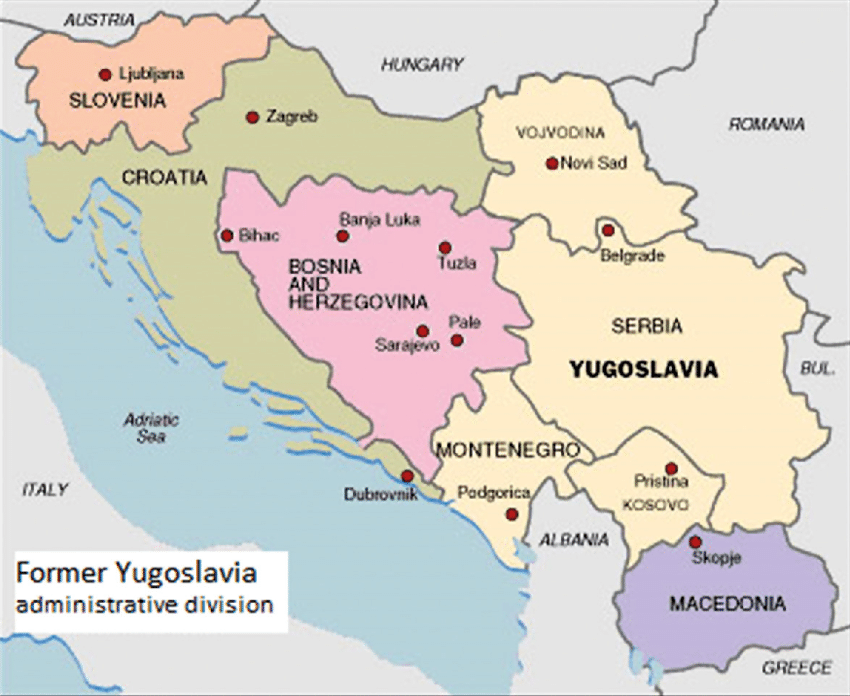
So for now, I began reading a duodecimo1 book which had a title that claimed it was for beginners, and even brought it to school. At first I thought that I should start by checking Yugoslavia’s location, but that was a trivial matter. A world map would be enough for that. With that realization, I decided to look at the atlas we used for our World History classes. All I had to do was open the cover and study the world map as described by the Mercator projection.
I was in my classroom after school.
Normally, I would read novels for entertainment, but I’d never brought a book and pored over it in my classroom. No matter how interested in a novel I was, I would always make it a point to read it at home. I knew that people who read books were a minority in a high school classroom, and I didn’t want to make an unsightly attempt to act like I was part of that minority.
But thanks to the upcoming entrance exams, I became able to cover up this incongruity. As I blended in with my other classmates, reading the book I’d shelled out a hefty sum for, Fumihara came in. He seemed to be stopping by on his way home.
“You sure are working hard.”
He said, before noticing that the book in my hands was not a textbook, reference book or problem set. He raised his eyebrows.
“…What are you reading?”
Instead of answering, I lifted my book to show its title. Fumihara examined it closely, then let out a short sigh. I wasn’t irked by that, but jokingly challenged him.
“What’s that sigh supposed to mean?”
“You bought it, didn’t you? That’s impressive. Couldn’t you have gone to the library?”
I laughed bitterly and shook my head.
“I checked. Neither the library here nor the municipal library have anything like this. Or maybe they do, but I couldn’t find it in half a day.”
“Half a day? That’s also impressive.”
Speaking in a voice low enough to not disturb those self-studying, Fumihara leaned on a nearby table.
I hadn’t noticed since I was immersed in reading, but it was raining. It was a strong rain, not just a gentle drizzle, but judging by the lack of puddles on the ground outside, it must have just started.
“But even when you bought this, Maja’s leaving soon, isn’t she?”
While looking at the rain, I nodded.
“Her two months is almost up, huh.”
“I suppose it takes time to get books you ordered. They don’t arrive in time.”
Upon hearing those words of sympathy, I smiled and returned my gaze from the rain to Fumihara.
“It’s not that they don’t arrive in time. Did you think that I bought this book just to be able to communicate with Maja?”
“Was it not for that?”
“Well, to be frank, that’s not entirely untrue, but…”
After inserting a bookmark, I closed the book. Then, I placed an elbow on the book and rested my chin on that hand.
It was certainly quite natural for Fumihara to make that assumption. Even if he was serious to a tee, he wasn’t made of wood or stone, and I also had blood flowing in my veins. With such a girl around, it probably wasn’t unreasonable to want to be able to talk with her.
But that wasn’t all. That wasn’t the only reason why I shut myself in the library and paid through the nose for those books. I was clearly aware of that, but how should I explain it? Being unable to articulate my own thoughts and actions made me feel bad, so I decided to try putting together some words in my head.
I drummed the fingers of my other hand on the cover of the book.
In my mind, there was an image that had not been transformed into words. It was a circle.
The circle was surrounded by a gloomy fog, but a spotlight shone within it. I was in the circle, along with Fumihara, Tachiarai and Shirakawa. I was standing relatively close to the center, and so was Fumihara. Shirakawa was the closest to the center, and Tachiarai was undoubtedly near the edge, but we were all still in the same circle in the end. We would compete in the circle, and either win or lose. None of us would proudly admit it, but it seemed that just being in the circle allowed us to survive.
But one day, Maja jumped right into our circle. From what I heard, she’d come in from an entirely different circle. I’d heard the rumors, but I was shocked. “Is that even possible?” I thought. No, my surprise was probably more along the lines of, “Ah, now that you mention it, that method also exists.”
That was when an idea hit me. If she was able to come over here, we would definitely be able to go over there. And with that, I wouldn’t just be in the circle, but I would become part of it.
Now to put that in words…
“Well…”
I muttered.
But then I stopped. Perhaps I was hesitant to speak about this in public, and I also realized that I didn’t have the obligation to explain it to Fumihara. And most significantly, everything would no doubt become more trivial when put into words.
In place of that, I put on a grin.
“How about I tell you about Yugoslavia? I don’t mean to brag, but I’m the person most informed about Yugoslavia in this school right now.”
Either due to dissatisfaction at me changing the subject or for some other reason, Fumihara frowned.
“Nah, you don’t need to.”
“Don’t be shy. Geopolitical borders are shifting. Do you know the area south of Austria?”
“My elective is Japanese History.”
“Don’t you have space for extra knowledge?”
Fumihara got off the table he was sitting on. After taking a glance at the clock hung above the blackboard, he replied.
“I appreciate your efforts, but I think it’s impossible for me to get involved in things beyond what my hands can reach.”
“What your hands can reach? Is that a metaphor?”
“No, I mean it literally. In the end, it all comes down to physical limits.”
That was certainly a way of looking at it.
“Bye.” Leaving behind a simple greeting, Fumihara went home. I stopped resting my chin, and opened the book again.
I also opened a notebook and picked up a ball-point pen. Since I was reading a continuous stream of unfamiliar words, I wouldn’t be able to follow without taking down some notes.
Deciding that it would be helpful to tabulate the basic data of each republic in Yugoslavia, I also retrieved a ruler from my pen case.
| Republic Name | Slovenia | Croatia | Serbia | Montenegro | Bosnia and Herzegovina | Macedonia |
| Land Area (10,000 km2) | Approx 2.0 | Approx 5.7 | Approx 8.8 | Approx 1.4 | Approx 5.1 | Approx 2.6 |
| Population (10,000 People) | 1,963 | 4,760 | 9,779 | 615 | 4,355 | 2,034 |
| Main Ethnic Composition | Slovene: 87.6% | Croat: 77.9% Serb: 12.2% | Serb: 65.9% Albanian: 17.1% | Montenegrin: 61.9% Muslim: 14.6% | Muslim: 43.7% Serb: 31.4% Croat: 17.3% | Macedonian: 64.6% Albanian: 21.0% |
| Main Religions | Catholicism | Catholicism, Serbian Orthodox Church | Serbian Orthodox Church, Islam | Serbian Orthodox Church | Islam, Serbian Orthodox Church, Catholicism | Macedonia Orthodox Church, Islam |
| Main Languages | Slovene | Serbo-Croatian | Serbo-Croatian | Serbo-Croatian | Serbo-Croatian | Macedonian |
| GNP per capita (USD) | 6,280 | 3,757 | 2,579 | 2,089 | 1,968 | 1,918 |
| Capital City | Ljubljana | Zagreb | Beograd2 | Titograd3 | Sarajevo | Skopje |
Yugoslavia is located in the Balkan Peninsula.
It has a population of about 23.5 million and an area of approximately 255,800 square kilometers. Its population density cannot be compared with Japan’s. It borders Italy to the west, Austria, Hungary and Romania to the north, Bulgaria to the east, Greece to the south, and Albania to the southwest.
The official languages of Yugoslavia are Slovene, Serbo-Croatian and Macedonian. The Latin Alphabet is mainly used in the north, while the Cyrillic Alphabet is mainly used in the south. Croatia’s Serbo-Croatian is slightly different from Serbia’s Serbo-Croatian, but the difference is smaller than that between American and British English. They can also be said to have a similar relationship as the one between Tokyo’s and Osaka’s dialects.
There are three main religions. Even under the communist regime, there were no religious persecutions, but it was thought that linking religion with nationalist movements would not help the federation, so it was not encouraged either. Exactly as Maja had told me at Tsukasa Shrine.
I decided to look a little deeper into each republic.
- Slovenia
The republic of Slovenia is small, but its GNP per capita is exceptionally high. It is closest to Western Europe on the map, and due to that, or perhaps due to some other factors, its income level is also the closest to Western Europe’s.
According to the tourist guide book, Slovenia’s capital, Ljubljana, has a population of roughly 320 thousand. Viewed from Ljubljana Castle, which is located on a hill, the streetscape is beautiful, with a mix of different architectures, like Renaissance, Baroque and Art Nouveau. The Ljubljanica River, which surrounds the hill Ljubljana Castle is built on, has some bridges designed by well-known architects, like Triple Bridge and Dragon Bridge. The former is a tourist spot, while the latter is a symbol of the city. Postojna Limestone Cave and Lake Bled are also popular attractions. In particular, there are over six thousand limestone caves in Slovenia. The land must contain a lot of calcium.
- Croatia
It has a long coastline, which is a narrow strip stretching from north to south, and looks like a fishing hook, or the letter J, on a map. In terms of GNP per capita, Croatia has the second highest among the republics in Yugoslavia. It is far behind the front runner, Slovenia, but is also far ahead of the other republics.
According to the tourist guide book, that long coastline is perfect for vacations. It stands to reason, for Croatia borders the Adriatic Sea. The capital, Zagreb, has a population of about 700 thousand. Gradec, a fortified city with historical value and Kaptol, a city centered around the archbishop’s residence, were rivals in the past, but were merged into Zagreb in the 16th century, which is quite similar to Akita. There are many Catholic buildings, or in other words many points of interests are churches. Zagreb is a city built on the northern bank of the Sava River, but recently some urban areas have been developed in the south.
- Serbia
It is landlocked, with plains in the north and mountains in the south. Its population is a cut above the rest, but its GNP per capita is low. Manpower is the basics of production, but having the basics alone is not sufficient.
For better or for worse, Serbia is the center of Yugoslavia. I won’t understand what that means if without reading more about it, but in any case, Serbia’s capital, Beograd, also serves as the capital of the Socialist Federal Republic of Yugoslavia. Serbia also consists of two autonomous provinces, Vojvodina and Kosovo. Their capitals are Novi Sad and Pristina respectively.
The tourist guide book gives only a brief introduction to Beograd. It has a population of roughly 116 thousand. It’s a city built at the confluence of the Sava River and the Danube River, which I’ve heard of before. Beograd means “white castle wall”. The book says that the attacking Turkish army gave it that name in the 14th century when they were struck by its beauty, but according to another book, in the 9th century it was already called Beograd, which translates to mean “white town”. There are some castle ruins at the confluence point of the Danube and Sava, and now it is a park that boasts an amazing view.
- Bosnia and Herzegovina
There are three main religions and ethnicities in this republic according to the graph, but it is not clear as to which is the dominant one. This is reflected in the name Bosnia and Herzegovina. Out of the six republics in Yugoslavia, five of them have a name associated with their main ethnicity, but Bosnia and Herzegovina is the geographical name.
According to the tourist guide book, Stari Most is a beautiful bridge. The capital of Sarajevo has a population of approximately 300 thousand. Photos of Sarajevo contain multiple minarets, showing that the Muslim population there is indeed quite big. The Miljacka River flows from east to west, straight through the city’s center. Upstream of that is an Arabic-style library that is apparently worth a visit. I’ve heard the name Sarajevo before, and that is because it is where that famous assassination of the Austrian Crown prince took place, an event that according to my textbook was the pretext for World War I.
- Montenegro
It has a population of about 612 thousand, which is lower than that of Sakai in Japan, and just a little higher than that of Okayama.
Montenegro has a coastline, but most of the land is made up of mountains. This mountainous terrain is the cause of an interesting aspect of Montenegro. Unlike the rest of the Balkan peninsula, it has maintained independence throughout its history.
There are no pages on Montenegro in the tourist guide book. I don’t know if it’s because there are too many mountainous areas, or because the tourism industry has not developed enough yet. The capital is Titograd. It has a population of roughly 60 thousand. The description of this city is also lackluster. All it says is that “There is a Partisan4 monument, but not much historical remains due to the war.” Of course, “war” in this case refers to World War II.
- Macedonia
It has the lowest GNP per capita out of the six republics, but there is not much difference among the lowest three. Incidentally, these three with the lowest GNP per capita are also the three south-most republics in Yugoslavia. Looking at the table and map, it is clear that the republics of Yugoslavia are richer the farther north they are, and poorer the farther south they are.
Once again, according to the tourist guide book, while the north-most Slovenia has Lake Bled, the south-most Macedonia also has a lake called Ohrid, and it is also beautiful. The capital, Skopje, has a population of approximately 320 thousand, and every book opens with a note that it was destroyed in a 1963 earthquake. After the earthquake, the area around the station was redeveloped in a postmodern style. Looking at the photos, “postmodern” seems to mean “with a twist”. These postmodern style streets continue until the Stone Bridge which was built during the Ottoman period. On the other side of this bridge is the old town with its Turkish streets and architecture.
After completing the text-based simulated experience of Yugoslavia, I looked outside to notice that the overcast rain clouds had gotten darker. The rain didn’t seem to be stopping any time soon. I also found Tachiarai next to me. She’d pulled over a random chair, was sitting on it like she owned it, and was holding open a book with her right hand.
Surprise ran through my body.
In an act to feign composure, I did a light stretch.
“Oh, I didn’t notice you. Since when were you here?”
Tachiarai raised her head.
“Just now. I haven’t even finished reading a page.”
“You could have said something.”
“You seemed to be absorbed in your book.”
“I’ve got a lot of customers today. Earlier, Fumihara also came over.”
Tachiarai closed her book with her right hand. She then stood up, pushed the chair back to where it was from, and stood next to me.
“Really? What a coincidence.”
She peeked at the book in my hands.
“What are you reading?”
She’d also been reading, but she only asked about my book. Like with Fumihara, I lifted the book to show its title.
“Fumihara asked the same thing.”
“Huh, another coincidence.”
With that, Tachiarai looked at the book’s title. She sighed.
“So you’re also curious, Moriya-kun.”
While I was a little confused by her straightforward words, I answered honestly.
“Guess there’s no point trying to hide it. I am curious.”
“It’s the same for me. Maja said that it’s fine, but that sounded to me like she was hiding something.”
Tachiarai slightly cast her eyes down. In contrast, I looked up at her.
“…What are you talking about?”
Though we hadn’t planned it, we ended up being face to face with each other. An expression of doubt appeared on Tachiarai’s face, as if she wanted to ask, “What is this guy saying?” But on my face was probably a similar expression that read, “What is this girl saying to me?”
“Did something happen to Maja?”
Tachiarai’s face returned to its usual listless countenance.
“Moriya-kun, are you keeping up with the news?”
“Not really. I’ve been occupied with this the past few days.”
I knocked the book and replied. Tachiarai nodded.
“I didn’t expect that.”
She said, then closed her mouth. It seemed like she was searching for the right words to say. I felt uncomfortable, not from her words, but from this rare behavior.
Unable to wait for her any longer, I repeated my question.
“Did something happen?”
Tachiarai shook her head, causing her long hair to sway behind her.
“Nothing. Not yet. And even from now on, probably nothing.”
“…”
“Yesterday, Maja’s country…”
But before she could finish her sentence, a loud voice cut her off.
“Machi!”
I turned around to see Shirakawa standing on the other side of the open door. She was a little wet from the rain, and was holding what looked to be a newspaper in her hand. Without looking at me, she trotted towards Tachiarai and opened the newspaper, which had turned mousy gray in patches due to the rain. The fact that she rushed here to show it to us meant that it must be the evening paper.
Her breath ragged, Shirakawa pointed at a corner of a page. Tachiarai looked down at the newspaper, and I also read the article.
It had the headline “Escalation Towards Armed Conflict in Yugoslavia”.
“…What the heck?”
I instinctively muttered.
Tachiarai’s quiet voice answered my question.
“Yesterday, in Maja’s country, some republics declared independence. But Maja said nothing would happen.”
After a pause for me to digest those words, she added another line.
“But it seems that didn’t come true.”
The violent rain wouldn’t calm down. Thunder began to rumble in the distance.
A Break, and a Short Conversation | Contents | Chapter 2 Part 2
Patreon Supporters
Editors (Tier 2): Dedavond, Pearl H Nettle, David Liu
Assistants (Tier 1) : Rolando Sanchez, Lilliam
Thank you very much for all your support!