
A Break, and a Short Conversation | Contents | Chapter 3
Table of Contents
1
June 27, 1991 (Heisei 3) – Thursday
My wallet became quite a lot lighter in the last two weeks.
That was because the books on Yugoslavia I ordered kept getting delivered one after another.
Given that I usually only bought comics, paperbacks, or pocket books, buying hardcovers was something that I had to resolve myself for. I had to cough up a great deal of the money I’d saved up while secretly working part time, too. However, I did not feel a shred of regret upon seeing my empty wallet. It was just money I’d hoarded for no particular reason, and it wouldn’t have been used for anything useful, anyway.
So for now, I began reading a duodecimo1 book which had a title that claimed it was for beginners, and even brought it to school. At first I thought that I should start by checking Yugoslavia’s location, but that was a trivial matter. A world map would be enough for that. With that realization, I decided to look at the atlas we used for our World History classes. All I had to do was open the cover and study the world map as described by the Mercator projection.
I was in my classroom after school.
Normally, I would read novels for entertainment, but I’d never brought a book and pored over it in my classroom. No matter how interested in a novel I was, I would always make it a point to read it at home. I knew that people who read books were a minority in a high school classroom, and I didn’t want to make an unsightly attempt to act like I was part of that minority.
But thanks to the upcoming entrance exams, I became able to cover up this incongruity. As I blended in with my other classmates, reading the book I’d shelled out a hefty sum for, Fumihara came in. He seemed to be stopping by on his way home.
“You sure are working hard.”
He said, before noticing that the book in my hands was not a textbook, reference book or problem set. He raised his eyebrows.
“…What are you reading?”
Instead of answering, I lifted my book to show its title. Fumihara examined it closely, then let out a short sigh. I wasn’t irked by that, but jokingly challenged him.
“What’s that sigh supposed to mean?”
“You bought it, didn’t you? That’s impressive. Couldn’t you have gone to the library?”
I laughed bitterly and shook my head.
“I checked. Neither the library here nor the municipal library have anything like this. Or maybe they do, but I couldn’t find it in half a day.”
“Half a day? That’s also impressive.”
Speaking in a voice low enough to not disturb those self-studying, Fumihara leaned on a nearby table.
I hadn’t noticed since I was immersed in reading, but it was raining. It was a strong rain, not just a gentle drizzle, but judging by the lack of puddles on the ground outside, it must have just started.
“But even when you bought this, Maja’s leaving soon, isn’t she?”
While looking at the rain, I nodded.
“Her two months is almost up, huh.”
“I suppose it takes time to get books you ordered. They don’t arrive in time.”
Upon hearing those words of sympathy, I smiled and returned my gaze from the rain to Fumihara.
“It’s not that they don’t arrive in time. Did you think that I bought this book just to be able to communicate with Maja?”
“Was it not for that?”
“Well, to be frank, that’s not entirely untrue, but…”
After inserting a bookmark, I closed the book. Then, I placed an elbow on the book and rested my chin on that hand.
It was certainly quite natural for Fumihara to make that assumption. Even if he was serious to a tee, he wasn’t made of wood or stone, and I also had blood flowing in my veins. With such a girl around, it probably wasn’t unreasonable to want to be able to talk with her.
But that wasn’t all. That wasn’t the only reason why I shut myself in the library and paid through the nose for those books. I was clearly aware of that, but how should I explain it? Being unable to articulate my own thoughts and actions made me feel bad, so I decided to try putting together some words in my head.
I drummed the fingers of my other hand on the cover of the book.
In my mind, there was an image that had not been transformed into words. It was a circle.
The circle was surrounded by a gloomy fog, but a spotlight shone within it. I was in the circle, along with Fumihara, Tachiarai and Shirakawa. I was standing relatively close to the center, and so was Fumihara. Shirakawa was the closest to the center, and Tachiarai was undoubtedly near the edge, but we were all still in the same circle in the end. We would compete in the circle, and either win or lose. None of us would proudly admit it, but it seemed that just being in the circle allowed us to survive.
But one day, Maja jumped right into our circle. From what I heard, she’d come in from an entirely different circle. I’d heard the rumors, but I was shocked. “Is that even possible?” I thought. No, my surprise was probably more along the lines of, “Ah, now that you mention it, that method also exists.”
That was when an idea hit me. If she was able to come over here, we would definitely be able to go over there. And with that, I wouldn’t just be in the circle, but I would become part of it.
Now to put that in words…
“Well…”
I muttered.
But then I stopped. Perhaps I was hesitant to speak about this in public, and I also realized that I didn’t have the obligation to explain it to Fumihara. And most significantly, everything would no doubt become more trivial when put into words.
In place of that, I put on a grin.
“How about I tell you about Yugoslavia? I don’t mean to brag, but I’m the person most informed about Yugoslavia in this school right now.”
Either due to dissatisfaction at me changing the subject or for some other reason, Fumihara frowned.
“Nah, you don’t need to.”
“Don’t be shy. Geopolitical borders are shifting. Do you know the area south of Austria?”
“My elective is Japanese History.”
“Don’t you have space for extra knowledge?”
Fumihara got off the table he was sitting on. After taking a glance at the clock hung above the blackboard, he replied.
“I appreciate your efforts, but I think it’s impossible for me to get involved in things beyond what my hands can reach.”
“What your hands can reach? Is that a metaphor?”
“No, I mean it literally. In the end, it all comes down to physical limits.”
That was certainly a way of looking at it.
“Bye.” Leaving behind a simple greeting, Fumihara went home. I stopped resting my chin, and opened the book again.
I also opened a notebook and picked up a ball-point pen. Since I was reading a continuous stream of unfamiliar words, I wouldn’t be able to follow without taking down some notes.
Deciding that it would be helpful to tabulate the basic data of each republic in Yugoslavia, I also retrieved a ruler from my pen case.
| Republic Name | Slovenia | Croatia | Serbia | Montenegro | Bosnia and Herzegovina | Macedonia |
| Land Area (10,000 km2) | Approx 2.0 | Approx 5.7 | Approx 8.8 | Approx 1.4 | Approx 5.1 | Approx 2.6 |
| Population (10,000 People) | 1,963 | 4,760 | 9,779 | 615 | 4,355 | 2,034 |
| Main Ethnic Composition | Slovene: 87.6% | Croat: 77.9% Serb: 12.2% | Serb: 65.9% Albanian: 17.1% | Montenegrin: 61.9% Muslim: 14.6% | Muslim: 43.7% Serb: 31.4% Croat: 17.3% | Macedonian: 64.6% Albanian: 21.0% |
| Main Religions | Catholicism | Catholicism, Serbian Orthodox Church | Serbian Orthodox Church, Islam | Serbian Orthodox Church | Islam, Serbian Orthodox Church, Catholicism | Macedonia Orthodox Church, Islam |
| Main Languages | Slovene | Serbo-Croatian | Serbo-Croatian | Serbo-Croatian | Serbo-Croatian | Macedonian |
| GNP per capita (USD) | 6,280 | 3,757 | 2,579 | 2,089 | 1,968 | 1,918 |
| Capital City | Ljubljana | Zagreb | Beograd2 | Titograd3 | Sarajevo | Skopje |
Yugoslavia is located in the Balkan Peninsula.
It has a population of about 23.5 million and an area of approximately 255,800 square kilometers. Its population density cannot be compared with Japan’s. It borders Italy to the west, Austria, Hungary and Romania to the north, Bulgaria to the east, Greece to the south, and Albania to the southwest.
The official languages of Yugoslavia are Slovene, Serbo-Croatian and Macedonian. The Latin Alphabet is mainly used in the north, while the Cyrillic Alphabet is mainly used in the south. Croatia’s Serbo-Croatian is slightly different from Serbia’s Serbo-Croatian, but the difference is smaller than that between American and British English. They can also be said to have a similar relationship as the one between Tokyo’s and Osaka’s dialects.
There are three main religions. Even under the communist regime, there were no religious persecutions, but it was thought that linking religion with nationalist movements would not help the federation, so it was not encouraged either. Exactly as Maja had told me at Tsukasa Shrine.
I decided to look a little deeper into each republic.
- Slovenia
The republic of Slovenia is small, but its GNP per capita is exceptionally high. It is closest to Western Europe on the map, and due to that, or perhaps due to some other factors, its income level is also the closest to Western Europe’s.
According to the tourist guide book, Slovenia’s capital, Ljubljana, has a population of roughly 320 thousand. Viewed from Ljubljana Castle, which is located on a hill, the streetscape is beautiful, with a mix of different architectures, like Renaissance, Baroque and Art Nouveau. The Ljubljanica River, which surrounds the hill Ljubljana Castle is built on, has some bridges designed by well-known architects, like Triple Bridge and Dragon Bridge. The former is a tourist spot, while the latter is a symbol of the city. Postojna Limestone Cave and Lake Bled are also popular attractions. In particular, there are over six thousand limestone caves in Slovenia. The land must contain a lot of calcium.
- Croatia
It has a long coastline, which is a narrow strip stretching from north to south, and looks like a fishing hook, or the letter J, on a map. In terms of GNP per capita, Croatia has the second highest among the republics in Yugoslavia. It is far behind the front runner, Slovenia, but is also far ahead of the other republics.
According to the tourist guide book, that long coastline is perfect for vacations. It stands to reason, for Croatia borders the Adriatic Sea. The capital, Zagreb, has a population of about 700 thousand. Gradec, a fortified city with historical value and Kaptol, a city centered around the archbishop’s residence, were rivals in the past, but were merged into Zagreb in the 16th century, which is quite similar to Akita. There are many Catholic buildings, or in other words many points of interests are churches. Zagreb is a city built on the northern bank of the Sava River, but recently some urban areas have been developed in the south.
- Serbia
It is landlocked, with plains in the north and mountains in the south. Its population is a cut above the rest, but its GNP per capita is low. Manpower is the basics of production, but having the basics alone is not sufficient.
For better or for worse, Serbia is the center of Yugoslavia. I won’t understand what that means if without reading more about it, but in any case, Serbia’s capital, Beograd, also serves as the capital of the Socialist Federal Republic of Yugoslavia. Serbia also consists of two autonomous provinces, Vojvodina and Kosovo. Their capitals are Novi Sad and Pristina respectively.
The tourist guide book gives only a brief introduction to Beograd. It has a population of roughly 116 thousand. It’s a city built at the confluence of the Sava River and the Danube River, which I’ve heard of before. Beograd means “white castle wall”. The book says that the attacking Turkish army gave it that name in the 14th century when they were struck by its beauty, but according to another book, in the 9th century it was already called Beograd, which translates to mean “white town”. There are some castle ruins at the confluence point of the Danube and Sava, and now it is a park that boasts an amazing view.
- Bosnia and Herzegovina
There are three main religions and ethnicities in this republic according to the graph, but it is not clear as to which is the dominant one. This is reflected in the name Bosnia and Herzegovina. Out of the six republics in Yugoslavia, five of them have a name associated with their main ethnicity, but Bosnia and Herzegovina is the geographical name.
According to the tourist guide book, Stari Most is a beautiful bridge. The capital of Sarajevo has a population of approximately 300 thousand. Photos of Sarajevo contain multiple minarets, showing that the Muslim population there is indeed quite big. The Miljacka River flows from east to west, straight through the city’s center. Upstream of that is an Arabic-style library that is apparently worth a visit. I’ve heard the name Sarajevo before, and that is because it is where that famous assassination of the Austrian Crown prince took place, an event that according to my textbook was the pretext for World War I.
- Montenegro
It has a population of about 612 thousand, which is lower than that of Sakai in Japan, and just a little higher than that of Okayama.
Montenegro has a coastline, but most of the land is made up of mountains. This mountainous terrain is the cause of an interesting aspect of Montenegro. Unlike the rest of the Balkan peninsula, it has maintained independence throughout its history.
There are no pages on Montenegro in the tourist guide book. I don’t know if it’s because there are too many mountainous areas, or because the tourism industry has not developed enough yet. The capital is Titograd. It has a population of roughly 60 thousand. The description of this city is also lackluster. All it says is that “There is a Partisan4 monument, but not much historical remains due to the war.” Of course, “war” in this case refers to World War II.
- Macedonia
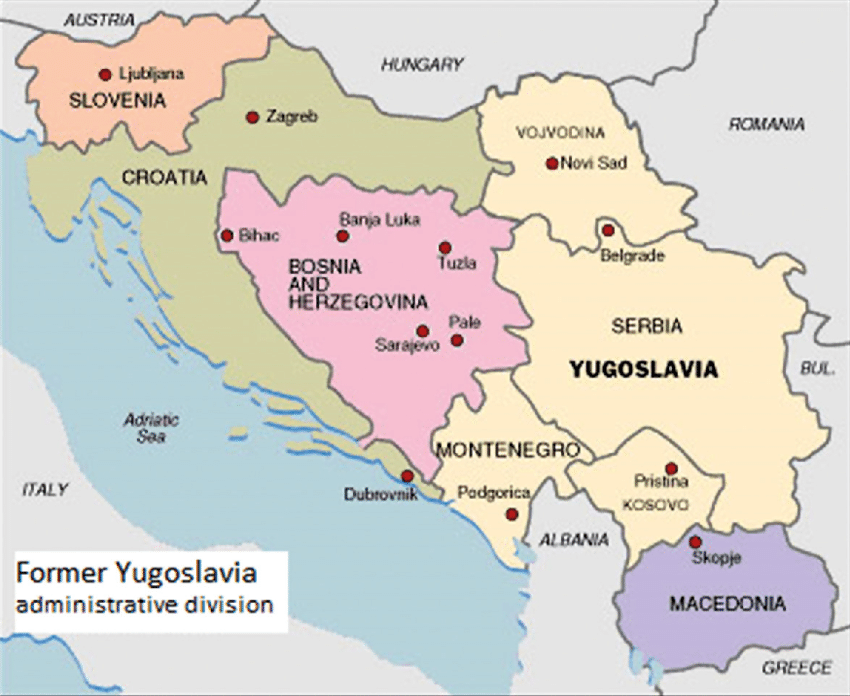
It has the lowest GNP per capita out of the six republics, but there is not much difference among the lowest three. Incidentally, these three with the lowest GNP per capita are also the three south-most republics in Yugoslavia. Looking at the table and map, it is clear that the republics of Yugoslavia are richer the farther north they are, and poorer the farther south they are.
Once again, according to the tourist guide book, while the north-most Slovenia has Lake Bled, the south-most Macedonia also has a lake called Ohrid, and it is also beautiful. The capital, Skopje, has a population of approximately 320 thousand, and every book opens with a note that it was destroyed in a 1963 earthquake. After the earthquake, the area around the station was redeveloped in a postmodern style. Looking at the photos, “postmodern” seems to mean “with a twist”. These postmodern style streets continue until the Stone Bridge which was built during the Ottoman period. On the other side of this bridge is the old town with its Turkish streets and architecture.
After completing the text-based simulated experience of Yugoslavia, I looked outside to notice that the overcast rain clouds had gotten darker. The rain didn’t seem to be stopping any time soon. I also found Tachiarai next to me. She’d pulled over a random chair, was sitting on it like she owned it, and was holding open a book with her right hand.
Surprise ran through my body.
In an act to feign composure, I did a light stretch.
“Oh, I didn’t notice you. Since when were you here?”
Tachiarai raised her head.
“Just now. I haven’t even finished reading a page.”
“You could have said something.”
“You seemed to be absorbed in your book.”
“I’ve got a lot of customers today. Earlier, Fumihara also came over.”
Tachiarai closed her book with her right hand. She then stood up, pushed the chair back to where it was from, and stood next to me.
“Really? What a coincidence.”
She peeked at the book in my hands.
“What are you reading?”
She’d also been reading, but she only asked about my book. Like with Fumihara, I lifted the book to show its title.
“Fumihara asked the same thing.”
“Huh, another coincidence.”
With that, Tachiarai looked at the book’s title. She sighed.
“So you’re also curious, Moriya-kun.”
While I was a little confused by her straightforward words, I answered honestly.
“Guess there’s no point trying to hide it. I am curious.”
“It’s the same for me. Maja said that it’s fine, but that sounded to me like she was hiding something.”
Tachiarai slightly cast her eyes down. In contrast, I looked up at her.
“…What are you talking about?”
Though we hadn’t planned it, we ended up being face to face with each other. An expression of doubt appeared on Tachiarai’s face, as if she wanted to ask, “What is this guy saying?” But on my face was probably a similar expression that read, “What is this girl saying to me?”
“Did something happen to Maja?”
Tachiarai’s face returned to its usual listless countenance.
“Moriya-kun, are you keeping up with the news?”
“Not really. I’ve been occupied with this the past few days.”
I knocked the book and replied. Tachiarai nodded.
“I didn’t expect that.”
She said, then closed her mouth. It seemed like she was searching for the right words to say. I felt uncomfortable, not from her words, but from this rare behavior.
Unable to wait for her any longer, I repeated my question.
“Did something happen?”
Tachiarai shook her head, causing her long hair to sway behind her.
“Nothing. Not yet. And even from now on, probably nothing.”
“…”
“Yesterday, Maja’s country…”
But before she could finish her sentence, a loud voice cut her off.
“Machi!”
I turned around to see Shirakawa standing on the other side of the open door. She was a little wet from the rain, and was holding what looked to be a newspaper in her hand. Without looking at me, she trotted towards Tachiarai and opened the newspaper, which had turned mousy gray in patches due to the rain. The fact that she rushed here to show it to us meant that it must be the evening paper.
Her breath ragged, Shirakawa pointed at a corner of a page. Tachiarai looked down at the newspaper, and I also read the article.
It had the headline “Escalation Towards Armed Conflict in Yugoslavia”.
“…What the heck?”
I instinctively muttered.
Tachiarai’s quiet voice answered my question.
“Yesterday, in Maja’s country, some republics declared independence. But Maja said nothing would happen.”
After a pause for me to digest those words, she added another line.
“But it seems that didn’t come true.”
The violent rain wouldn’t calm down. Thunder began to rumble in the distance.
2
June 30, 1991 (Heisei 3) – Sunday
What in the world were my eyes seeing? I definitely hadn’t closed my ears, either.
After scouring the newspapers, I discovered that the morning paper from 26th June had already reported on Slovenia and Croatia declaring independence. It also included an excerpt from a speech by the Chairman of Slovenia’s National Assembly, Kučan. “Through birth man acquires the right to dreams. Through work he acquires the right to draw life and dreams together. Yesterday we linked the two together; for ourselves, for many generations of Slovenes, who long ago dreamt those same dreams and for future generations, who will build a new world upon those dreams.” And the evening paper from the 27th reported that the Yugoslav People’s Army invaded Slovenia’s territory.
I was under the impression that I knew some things about Yugoslavia, but that was an overly optimistic assessment. I was completely unaware that some ominous turmoil had been brewing within the country. Come to think of it, the eastern regions of Europe had been turbulent in the past few years, starting from 1989. There were all sorts of news articles about it, but I never imagined that it would be relevant to the people around me.
Swayed by scant information, I spent my days in a stupor, as if I was dreaming. But Shirakawa must have been impacted harder than me. She did tell me about Maja’s state, but would sometimes ramble incoherently about something else. Still, according to what I heard from her, Maja had borrowed their phone to make some calls to somewhere, but had not seemed upset.
In Shirakawa’s words, “Maja was not excited, or sad. She was quieter than I thought she would be, and kept her cool, but I felt…”
After agonizing over it for a moment, she finally completed her sentence, apparently unable to find any other way to express her thoughts.
“…That she was angry.”
Three days passed.
The civil war was starting to subside, almost anticlimactically so.
The Yugoslav People’s Army overwhelmed the Republic of Slovenia’s outnumbered defense forces, bombed the airport in Slovenia’s capital Ljubljana, and closed the borders. On top of that, a three-month freeze on the declaration of independence was quickly established through EC5 mediation.
The footage of armored personnel carriers was too ominous, and with the Gulf War still fresh in my mind, I’d thought the situation to be more serious than it actually was. But it was all much ado about nothing. I’d freaked out and gotten cold feet over a minor matter that ended in just four days. Unfortunately, about forty or so people were killed, but the war was over. Yugoslavia may have faltered a little, but it would probably soon recover. And one day, it would welcome Maja with open arms when she comes into her own. There were no problems at all. No, some problems remained, but they were not significant ones.
On that morning, the skies were clear.
There was some homework for English class, so I planned to complete it at the municipal library. It probably wouldn’t take more than half an hour, so I decided to do a refresher on idioms as well. I’d dropped the ball and forgotten that the next standardized assessment would be for English. It wasn’t a subject that I struggled with, but perhaps that was a reason for my complacence. I was just thinking that I needed to do some revision. A brilliant way of spending a Sunday in which I had nothing to do.
I knew it myself, but what I wanted a refresher on was not idioms, but on the fact that I was a student who was about to take entrance examinations. Eastern Europe would take up only a minuscule part of those exams. No matter how much attention I paid to Yugoslavia, it would make little to no contribution towards my primary role. I had to let it go, and work on my exam preparations. But even while I was aware of that, the bag I was carrying contained three of the books I’d bought. It was something I couldn’t quite let go.
Eventually, many clouds gathered above, but it was still a hot day. It would be July starting from tomorrow. Summer was close by, or rather, it was already summer. It would take me roughly twenty minutes to get to the municipal library from my house by bicycle. Whenever I braked at an intersection, I would take a pocket towel out and use it to dab my forehead. Perhaps I should cut my hair a little shorter before the heat reached its peak.
Before leaving the house, I’d called Tachiarai, because I knew that she used the library a lot more frequently than I did. My read that she would also be using it today turned out to be correct, and she’d said that she would be going over. She should have reached the library now. I was still halfway, but there was no need for me to rush. Our phone call had gone like this.
“You going to the library?”
“Yeah.”
“I’ll also be going.”
“I see.”
“Looks like it’s going to be hot.”
“I suppose so.”
That was the conversation we’d had, though I would hesitate to call it that. We hadn’t made an agreement to go to the library or anything like that. That made me wonder why I even bothered to make a phone call, but this sort of thing wasn’t unusual when dealing with Tachiarai.
The English homework was a little tougher than I’d expected, so I was unable to breeze through it within half an hour. Even so, I finished it in one hour without needing to concentrate that much, then flipped to a random page in the idiom section of my vocabulary book and started re-memorizing some idioms. The six-person table I was at was filled with other students who were studying for entrance exams like me, and Tachiarai was sitting opposite me, solemnly attempting a mathematical problem.
After a while, my throat felt dry, so I stood up to buy a cup of iced coffee from the vending machine in the lobby. Tachiarai also came over, though she wasn’t chasing after me. Like me, she bought an iced coffee, but pushed the button to add more sugar. After taking a couple of sips from her coffee, she spoke to me in a small voice.
“You still looking into it?”
For a moment I wondered what she was talking about, but soon realized that it was the Yugoslavia matter. I nodded.
“So you’ve taken an interest in current affairs, huh?”
“It’s not like that.”
“Did you get any results? Do you understand the reason for the war, for example?”
Her tone made it seem like it was someone else’s problem, which caused me to feel a little annoyed. I drank a mouthful of coffee to calm myself down.
“I still don’t understand why those two republics tried to become independent. But I do somewhat understand why the six republics wanted to form a federation in the first place.”
“I see.”
Tachiarai glanced at the smoking corner. As could only happen on a Sunday afternoon, the library was crowded everywhere, and even the smoking corner was filled with men. After returning her gaze, she smiled only with her lips.
“It’s been a while. How about you talk to me about something?”
She gestured me to come with her to the smoking corner. It was partitioned off by a thin wall, and was one of the only places in the library you could openly talk at.
“About Yugoslavia?”
“Yeah, that’s fine.”
It was exactly what I wanted to do too. Talking to someone is the best way to organize what you’ve learned.
As Tachiarai had mentioned herself, it had certainly been a long time since she’d told me to talk to her about something. We put some distance between us and two men chatting up a storm about baseball, and sat next to each other on a bench. I quickly drained my iced coffee. Tachiarai had only drunk some coffee at the beginning, so the contents of her cup had almost not gone down at all. Lightly fanning away some smoke that had drifted near my face, I started talking.
“The word ‘Yugo’ means ‘South’. So ‘Yugoslavia’ means ‘Land of the South Slavs’. Yugoslavia is made up of six republics, which became one under the public stance that they are all made up of South Slavs.”
In general, Tachiarai never gave any agreeable responses. That made it hard to tell if she was listening to what someone was saying. However, I was used to that, so I didn’t mind the lack of feedback and instead focused on extracting the correct bits from my memory.
“So, Yugoslavia was formed for the ‘self-determination of South Slavs’, or at least that was the stated reason. The formation was not done due to the influence of foreign powers, but was a spontaneous act by the six republics.
“Now, as for the true reason for the merge, there were two main republics. One was Serbia, and the other was Croatia. Serbia was controlled by the Ottoman Empire, and Croatia was part of the Habsburg monarchy6. The Ottoman Empire became considerably weaker in the 19th century, and as a result Serbia became stronger. They established independence in the first half of the century.
“Serbia’s main ambition was to gather the territories where Serbs had been scattered into one country. On the other hand, Croatia wanted to consolidate the territories that used to be part of Croatia. I suppose you could call it their historical land.
“To meet those two goals, those two republics could merge, and kill two birds with one stone. But the Habsburg monarchy was a hindrance to that.”
“So the trigger for World War I was…”
She interjected, which was rare for her.
“…the war between Austria and Serbia, right?”
Impressed, I nodded.
“Serbia suffered huge casualties, but the Habsburg monarchy also collapsed as a result. Not tied down any longer, Croatia and Serbia formed a new country. With their languages being similar, they felt that they were part of the same ethnic group. I believe it was written that this merge was done under the influence of Romanticized ideals. Since the public reason for that was the self-determination of South Slavs, other groups of South Slavs came together as well.
“But it didn’t work out. There was no consensus among the South Slavs in the first place, so trying to create a shared sense of identity only led to contradictions. Serbia and Croatia came to be at odds with one another, and Yugoslavia was quickly split when War War II started. Serbia was on the side of the Axis Powers, while Croatia was on the side of the Allies, so they fought each other. That said, there were almost no conventional battles. Every piece of reading material said that both sides massacred the other.”
“I don’t think you can use the word ‘massacre’ for soldiers killing each other.”
“The soldiers killed civilians, which is why they hated each other to the bone.
“At that time, a third power appeared. You might know about it since you’re good at world history, but it was the Partisans, led by Tito. In the end, the Partisans won, and Yugoslavia became a socialist country. Tito decided not to forcibly establish Yugoslavia as a country of South Slavs, and instead gave each republic the right to self-governance.
“However, it was bad that they won without assistance from the Soviet Union. Yugoslavia, which maintained its political influence and was blessed with an excellent leader, was an eyesore for the Soviet Union. After the war, it was not accepted by the east, and also did not join the west, instead striking out on their own. Yugoslavia has been like this until today… and that is the end of my story.”
Tachiarai took another small sip of her iced coffee, in which almost all of the ice had melted.
“So it fell apart because it was a loveless marriage.”
I stared intently at her side profile, but all she did was add another statement in a disinterested manner.
“It would be easier if the situation could be summed up in that one line.”
I felt relieved hearing Tachiarai say that. Sure, the six republics of Yugoslavia definitely didn’t have a problem-free history. But saying that this situation was unavoidable because they had historically bad relationships with one another was something that I didn’t want to do. That would be a lack of understanding, or rather, an abandonment of understanding.
That said…
“But I still don’t know their motives for declaring independence.”
“Do you plan to look into it until you understand?”
“Asking Maja would be the best solution, but I can’t bring myself to do it, and I haven’t had the chance to, anyway.”
“So you’ll be working hard.”
“I suppose, but…”
I put on a mild grin.
“It’s good that there’s no need for me to be so serious about it. While there’s a civil war going on, it’s almost over, right? I’ll take it easy, and it’ll be great if I can see the actual place some day.”
But Tachiarai replied while looking forward, in a tone of voice that was the same as before.
“Really? Maja doesn’t seem to think so.”
For a moment, I was lost for words.
“What do you mean, she doesn’t seem to think so?”
“She thinks that it hasn’t ended… last night, I got a phone call from Izuru and Maja. She knew about the freeze on the declaration of independence, but said she doesn’t think it’s over.”
I couldn’t wrap my head around it.
“Why?”
I spoke too enthusiastically, and got some cigarette smoke in my throat. I coughed two or three times.
“…That’s a pessimistic view, isn’t it? Was there a reason for that?”
Tachiarai nodded blankly, then deliberately took a cigarette out of her pocket. But after taking a glance at me, she returned it to her pocket as slowly as she had when taking it out.
“A reason? She did say something about that, but if you want to know, I think it’s better to ask her directly.”
“I want to know now.”
“I see.”
Tachiarai then looked intently at my face.
“What is it?”
“Your face changed a little.”
“……”
“You’ve got quite a funny face on now.”
With that, she quickly stood up and left the smoking corner with her paper cup in hand. I sullenly trailed behind her.
From the smoking corner, we went back to the lobby and headed towards the open shelves. We wouldn’t draw the ire of others if we talked while we were still in the lobby. Tachiarai dumped the contents of her cup, which was still half full, into the ice disposal area, and also got rid of the cup.
“Sendou!”
I hissed, causing Tachiarai to turn her head slightly back.
“Maja says that the Yugoslav People’s Army won’t stop. The prime minister of Yugoslavia… Moriya-kun, do you know his name?”
“……”
“It’s Marković. Anyway, Marković cannot stop the People’s Army. And because of that, Slovenia also cannot be stopped. That was what she said.”
I couldn’t understand. It was beyond my comprehension.
Tachiarai stopped moving near the center of the lobby.
“Ah, another thing. Maja will leave Japan on the 10th of July. We’ll be throwing a farewell party for her, so Izuru asked if you’ll be joining. Maja apparently wants to try some Japanese sake.”
I gently cast my eyes to the ceiling.
“Maja’s… I thought her time here wouldn’t end, but she’s leaving, huh.”
I mused, but Tachiarai’s words were remarkably blunt in contrast.
“Seems like it.”
She didn’t mean any malice in that. It was just a normal response for her. I knew as much, but for a moment I was unable to prevent my irritation at her from flaring up. Before I knew it, I blurted out these words.
“Sendou. You don’t seem to care that Maja’s leaving, huh?”
She didn’t even raise an eyebrow.
“I suppose, but that’s not an entirely accurate way of putting it. I just find it weird to place my concern in something that Maja’s doing based on her convictions.”
What a thing to say!
“If so…”
I swallowed some saliva, before impulsively going on.
“For example, if I were to die, would you think it strange to place your concern in that?”
“Oh, Moriya-kun, you’re dying?”
“That’s just an example.”
A light grin formed on Tachiarai’s lips, or at least that was what it seemed like to me.
“That’s a bad example. I can’t answer to that.”
I couldn’t help but see that smile as one of mockery, although there was no way she would mock someone.
With a swish of her long hair, she turned on her heel. The tiled floor of the lobby produced squeaking sounds as she did so.
As my eyes followed her, I clenched my back teeth.
What Tachiarai said was sound. She was saying that it was weird to stick her nose into a decision that Maja had made after thinking long and hard about it. She was also saying that she couldn’t answer my example, when I hadn’t made up my mind yet. Both of them were natural conclusions.
Tachiarai hadn’t shown her true thoughts on the matter, and I could only draw out the most obvious words from her. I couldn’t help but feel utterly pathetic about that. Her smile probably looked like a mocking one to me because I’d noticed my own deplorability.
I reached the bookshelves, and was about to return to my seat.
At that moment, Tachiarai suddenly stood up, clearly smiling this time. She turned to me, and spoke to me in a whisper.
“Hey, Moriya-kun… you seem blissful, y’know?”
Ah…
After that, I was unable to study at all.
The sky was cloudy again on the way back.
After I got home, I rolled around in bed.
When you don’t know why you’re doing something, one option is to carry on with whatever it is you’re doing. The same goes for when you don’t know what exactly you want to do. That is easy in both cases. Or perhaps that is actually better for getting things done. This indifference can be transformed into a slogan: “Worry later, try now!” That is how mistakes do not get corrected, and are repeated in the future.
I didn’t know if it was a mistake taking a strong interest in Yugoslavia. At two in the morning, I decided to give up on thinking about it. But my stubbornness, nosy curiosity, and something else I couldn’t quite explain drove me to start my research again.
That something else could be, as Tachiarai had mentioned, my state of blissful ignorance. But if I were to live a long, drawn-out life anyway, I could deal with that issue later.
3
July 5, 1991 (Heisei 3) – Friday
It was nine days after the start of the war.
The war between Slovenia and Yugoslavia seemed to be almost over, which was a good thing.
The result was clear. Between the overwhelming Yugoslav People’s Army and the defense forces of a republic that had just declared its independence, the latter were victorious. The People’s Army had started its retreat.
Out of the ten thousand troops mobilized for the Yugoslav People’s Army, thirty percent of them were lost in the fighting. I’d heard someone knowledgeable about the military say that an army is destroyed when it loses thirty percent of its men. The idea is that if such a fraction of soldiers is injured or killed, more soldiers have to be put towards evacuation and other tasks, further splitting manpower. However, that did not apply in this case. According to the figures, 1277 soldiers were captured and 1712 more deserted. You could say that many of them did not have the will to fight, but that might be an oversimplification.
So the federal army was in the process of retreating, and both sides were already moving on to military negotiations for exchanging prisoners of war and other concessions. That should be a thing to be happy about. However…
The pieces of commentary on the television and newspapers were catching up to Maja’s opinion. They said that it wasn’t the end, that it wasn’t clear if Yugoslavia could retain the rest of the federation. Both America and the EC were leaning towards recognizing Slovenia’s independence. Did the phrase “ethnic self-determination” still carry a beautiful ring to it in Europe?
Though the plum rain hadn’t let up, it was abnormally hot today. Clouds filled the sky, but there was hardly any wind. Between the humid air and the lukewarm tap water, it felt extremely hot. It was a pain to maintain good sitting posture, but even if I were to place my head on my desk, the mugginess would be quite unpleasant. This weather took a turn for the worse after school.
I had an errand to run for the class, and I was thinking that I wouldn’t be able to complete it before it started raining. My prediction turned out to be on the mark, and the rain began before thirty minutes had even passed. It was strong, so I decided to wait for it to die down a little. The classroom windows were left open, but since there was no wind despite the intense downpour, the risk of rain getting into the classroom was negligible. On top of that, the reduced temperature made it feel like a cool evening breeze was running through the room, so no one went over to close the windows. As a result, the pitter-patter of raindrops loudly reverberated in the classroom, and with nothing to do besides await each monotonous note, a wave of drowsiness washed over me.
In an odd state where I was sleepy and not sleepy at the same time, I reflected on a variety of topics. For example, I pondered about the reason why I didn’t want Maja to return to her country, which wasn’t only that I was worried about her safety, and also how it would be too embarrassing to say such an egoistic thing to her. I also thought about how it wouldn’t be a final goodbye, and that we could see each other again if we wanted to, among other things. It seemed that since the day I met Maja, any thinking I did while it was raining would gravitate to her. The sleepiness intensified.
With my head being in a dreamlike trance, I could only stare blankly as Maja appeared before my eyes.
“……”
She was wearing a pink pair of pants, and a shirt with stripes in warm colors. The sleeves of her shirt and the hem of her pants were wet. I was thinking that I’d seen these clothes somewhere before, when it hit me that it was what she wore when we first met. After peeking at my sleepy face, Maja called out to me in a concerned manner.
“Um, Moriya-san?”
“…Ah, Maja, huh.”
She nodded, a light grin on her face.
“Yes.”
With a few gentle shakes of my head and a bout of tapping on my temple with an index finger, my senses returned. I was now fully awake. I interlaced my fingers on top of the table and spoke as if nothing had happened.
“Feels like I haven’t seen you for a long time.”
“Hm, that might be right.”
“Did you get caught in the rain?”
“Yes, though I only got a little wet.”
There was no change in Maja’s appearance since the last time I saw her, which was right before the war started. She still had black eyes and black hair, a somewhat childlike face and on it, her distinctively striking eyebrows. I felt slightly relieved.
“You look well.”
“It is thanks to your support.”
She gave me a deep bow. As I looked on at a loss as to how to respond, Maja raised her head, flashing a mischievous smile.
I scratched my nose with my little finger and intentionally cleared my throat. There should be all sorts of things I wanted to talk to or ask Maja about if I met her, but nothing came to mind at the moment. In the meantime, Maja looked around the classroom, and asked.
“I am looking for Izuru. Moriya-san, do you know where she is?”
Upon hearing her question, I knitted my brows.
“She’s not in her classroom?”
“No. I have asked a few different people, but they did not know.”
“What about Sen… Tachiarai?”
“I could not find her.”
I slowly stood up from my seat.
“Alright, let’s try finding them.”
Even though we were searching for two people, it didn’t take much effort. Thinking that we should first check if she was still in school, I headed towards the dimly lit entranceway to find that each of their shoe lockers only contained their indoor shoes.
“They must have gone home already. That’s a pity.”
Maja clamped her lips together, as if to say that it was indeed disappointing, but she shook her head slightly.
“There is no helping it. But that is fine.”
“It is?”
She nodded.
“I thought I should see this building one last time.”
She swiveled her head round again, scanning the entranceway that was lit only by the faint light from a fluorescent lamp.
“I also learned many things here… Even if I come back to Fujishiba, that will be a long time away. Perhaps when I become an old grandma.”
She then cast her eyes outwards, where it was still raining.
“Hm, the rain is strong.”
“Yeah, I intend to wait until it weakens.”
“I will also wait. Moriya-san, do you know a good place?”
I knew just the perfect place for that.
We went to an empty classroom in the Humanities Block. It was an air pocket I’d found within the school, a slightly dusty but quiet location. Maja opened a window and gazed at Fujishiba City, which was being hit by the rain. I took a few steps away from her, used a pocket towel to wipe a table and chair that was covered with chalk dust, then sat on the table.
Lightning flashed in the sky. With the amount of time it took for the resulting thunder to reach my ears, I estimated the distance of the thundercloud. It seemed to be far away.
Maja turned her body around and leaned on the window frame, with her back towards the rain. She then shrugged, as if in exasperation.
“Japan really does have a lot of rain.”
“But we hold up umbrellas when it rains.”
I joked, causing Maja to laugh.
“Hm, that seems like a long time ago.”
“You’re right.”
Even though that was only two months before.
I gently shook my head.
“…But Maja, it may be a lot, but we don’t have the most rain in the world, I think. Is there that little rain in Yugoslavia?”
Maja assertively nodded, clearly full of confidence.
“I spent some time researching it. In Juni, Fujishiba had an average rainfall of 250 milliliters. That is almost three, tri puta of what my city gets.”
“Three times, you mean?”
“Da. Exactly.”
I crossed my arms. She must have spent some time on it, but I didn’t think she would look into something like that. Honest words slipped out of my mouth.
“You’ve really done your research well.”
“You have also done research on Yugoslavia, right, Moriya-san?”
I was surprised.
“How did you know?”
“Um, Machi-san told me about it. She also said that you want to ask me about all sorts of things.”
Maja closed the window, shutting off the sounds of raindrops striking on various objects and causing a silence to fall. She sat down on a table that was diagonally across from mine, not minding that it was coated with chalk dust.
“If you have things to ask, feel free to ask me anything.”
She then closed an eye and added.
“If you do not ask now, you will only get to ask those questions when you become a grandpa.”
So Tachiarai told her? The first thought I had was that she was planning something. But Tachiarai wouldn’t use such a roundabout method, and simply might have mentioned it during the course of some other conversation.
I hadn’t expected Maja to bring it up herself, and that caught me by surprise, but I did have some questions for her. Actually, I wanted to ask a favor of her, but before that I should get a grasp on the current situation. After closing my eyes for a moment, I deliberately opened my mouth.
“Can I really ask you anything?”
“Hm, anything, as long as it is gentlemanly.”
“…Even about the war?”
Maja smiled with only her lips.
“Is there anything else you want to ask about?”
Of course.
I thought back to the past eight days. There should be many things that I didn’t understand, things that didn’t make sense to me. With Maja, I would also be able to supplement my knowledge with details on Yugoslavia’s history and social systems that cannot be covered in books. But before that, I asked this question.
“So… Maja, you’re going back?”
Maja opened her eyes wide in surprise. She probably hadn’t expected that question. But she soon regained her composure and gave a small nod.
“Yes, I will go back to my city, to my home.”
“Why?”
“Why? Moriya-san, a home is for going back to. I still have my home… also, that is the promise I had with my father. Did I not tell you at the start that I would be here for two months?”
I kept quiet. She was right. I knew it from the start.
“…Is that all you want to ask me?”
I firmly shook my head.
“No, there’s more… Did you know that a war might happen in Yugoslavia?”
“Yes. Um, I mean, no.”
“Which is it?”
Maja stared into space, seemingly trying to recall the past, and dangled her legs. Eventually, she spoke, though her words came out very slowly.
“…I did notice that all sorts of things were getting worse and worse.
“Um, three years ago, when I went to Macedonia, this happened. I talked to some small children, and they laughed at me. Why did they laugh. They said, ‘This person’s speaking Srpskohrvatskom!’ At that time, I…”
She hit herself in the head with a fist.
“I felt like this. I went to Macedonia before when I was a lot younger, and it was not like that. In just a few years, Macedonia’s heart moved away from Yugoslavia. And that did not only happen to Macedonia. I thought that Yugoslavia was starting to be hated.
“But that was just a hunch.”
“Was there anything else, besides that hunch?”
“Da. If it was only their hearts moving away, the problem might resolve itself with time. But the three things that all five ethnic groups of Yugoslavia view to be important were gone. And if they are gone, it is difficult for Yugoslavia to remain as one federation. That is what I thought. Moriya-san, do you know what these three things are?”
The things that, in a sense, bind Yugoslavia together… I could only think of one.
“President Tito.”
Maja exclaimed with delight.
“Da! Amazing!”
“That’s the only one I know.”
“Mm. The other two are SKJ, which is the political party, and JNA7, which is the army.”
She raised a finger as she brought up each point. She then thrust her right hand, which had three fingers up, towards me.
“Tito is human. He died.”
She put down one of her fingers.
“Yugoslavia is getting increasingly poorer. This causes the ruling political party to get hated. Last year, there was an election that recognized parties other than the SKJ. It is no longer considered to be of value.”
She put down another finger.
Only her index finger was left standing.
“There is a legend that the JNA protected Yugoslavia. It takes in people from every ethnic group, so it was precious to each ethnic group. But after Tito died, its spiritual power declined. This is what I thought… in this war, when Slovenia was the enemy, Slovene soldiers deserted. It is clear that the JNA is no longer important to them.”
Maja, retracted her hand, which was now a fist.
“…That is why I knew that a war might happen in Yugoslavia. Even so, I did not want to think that it would happen. That is why I decided that it would not happen.”
Her voice was quiet. In its core was something I couldn’t even begin to fathom.
So that’s why. The Yugoslav People’s Army had Slovenes in it. I could understand why they would desert upon seeing Slovenia’s defense forces. But I felt something else fell out of place. Without thinking, I murmured.
“So Yugoslavia’s army lost?”
Maja shook her head.
“They could not give it their all. They thought Slovenia to be weak from the beginning, but even if they knew that to be untrue, they were afraid of the EC.”
…I see, but…
“But even if those three things are gone, that isn’t a reason to declare independence, right? Is drifting apart a reason for bloodshed? Was that the ‘dream’?”
“Hm, I thought you would ask this question at the start.”
She then answered my question without a hint of hesitation, as if she’d actually written a script beforehand.
“Moriya-san, did you find out if Slovenia and Hrvatska are wealthy republics in Yugoslavia?”
I was about to nod, but stopped.
“Hrvatska?”
“In Japanese, it is called Croatia.”
Just like Japan and nippon, huh. Satisfied, I was able to nod.
“Did you find out how much each republic depends on the others?”
This time, I shook my head.
“I see. In Yugoslavia, each republic manages its own economy. Goods are often sold in the republic it was produced in.”
“…If that’s the case, they might be fine without Yugoslavia, but it shouldn’t be a hindrance to them, right?”
Maja grinned.
“Mm, Moriya-san, that was amazing. Let me be unfair to you for a bit. Why did Slovenia and Hrvatska think of Yugoslavia as a hindrance?”
I pondered about that question.
If I could take Maja’s claim that each republic manages its own economy at face value, there should be no annoying directives from the federal government. That fit with what I read about Yugoslavia being decentralized. What, then?
…I thought of all sorts of things, but in the end, I could only give up.
“It’s no use. I don’t know.”
“So I will reveal the answer.”
As if putting on airs, she cleared her throat.
“Each republic manages its own economy. But… that is not the case for taxes.”
“……”
“Money earned in the north is used in the south by Yugoslavia. Um, to put it in Japanese, it would be ‘Federal Development Funds’. The Slovenes and Croats say that they are supporting the south. Some might even think that their money is being stolen.
“I know a good Japanese word to describe that. To the north, the south is ‘baggage’.”
I was lost for words.
“So that’s why they declared independence? What about the fervent aspiration of the Slavs?”
“That is not completely absent. In Slovenia and Croatia in particular, there is a strong belief that they are part of Evropa, and not part of Azija in the south.
“…I remember that when we first met, you said that Yugoslavia is part of Eastern Europe, but Machi-san said that it is better to call it Central Europe. She was being considerate of me. In Slovenia and Hrvatska, there are many people who get a little annoyed when you say they are Central European, but they will get angry if you say they are Eastern European. So, there are people who want to move away from Yugoslavia.
“But Moriya-san, besides that, there is something a lot more important.”
Maja said as she sidled up to me while staying seated.
“This is a secret. Please do not tell this to anyone else.”
She stifled her voice, and spoke softly.
“A human can forget their father who was killed, but cannot forget when their money is stolen.”
It was like a whisper in my ear. For a moment, I lost my composure.
But when I came to, Maja was still sitting on the table soiled with chalk dust and was close to her original position, like she hadn’t moved at all.
…Suddenly, all sound seemed to fade away.
I wondered if there was some problem with my ears, but it was just the rain diminishing in intensity. Maja turned to look out the window, then checked her wristwatch and stood up.
“I have to get back to Izuru’s house by five. I need to prepare the plates.”
“Ah, I see.”
All I could manage was a half-hearted reply.
“You wanted to talk more with me, right?”
“Yeah, I wanted…”
But I couldn’t finish my sentence. I knew what I wanted to say, but I was overwhelmed by what Maja had told me. Without worrying about my wretchedness, Maja was already about to leave. When she opened the door, I barely managed to call out to stop her.
“Maja.”
“Yes?”
But all I could say was this.
“…I’ll bring a great present for you tomorrow.”
Maja beamed with wholehearted joy.
“Thank you very much! I will look forward to it. See you tomorrow, then.”
Left alone in the empty classroom, I also smiled.
But unlike Maja’s, it was a self-deprecating smile. With clenched fists, I strongly hit my thighs. Pain spread around my knees. I’d just confirmed what I didn’t need to confirm. As I thought, I was still ignorant and powerless.
Tomorrow would be the last day. I would have to make up my mind. If not, I would definitely regret it… Even when the sun set and it became dark, I did not move from that spot until a patrolling teacher told me off.
4
July 6, 1991 (Heisei 3) – Saturday
It was bright and sunny on the day of Maja’s departure.
After classes ended just past noon, I decided to head home first before going out again. It would be some time until the farewell party, and the gift I wanted to bring was safely stored at home. I placed the gift, which was wrapped in decorative paper, into the front basket of my bicycle, then moved off towards the party venue, Kikui.
To get there, I rode along the Atotsu River. For a short while before reaching the city center, the river showed its bare form, untouched by the levee protection work. Yesterday’s rain, which lasted till this morning, was considerably intense, causing the river to be a little swollen today. I looked at my wristwatch to find that I didn’t need to rush just yet. My pedaling intentionally slowed down, but that was just a futile attempt to delay the passage of time.
The color of sunlight was starting to resemble summer, but the greenery-filled path that carried the scent of splashing water was still cool. As I absentmindedly gazed at the water surface, I spotted a young tree that had been uprooted and was now flowing down the river. I stopped to watch it float further downstream, periodically sinking and rising in the process. At the moment I felt that I’d witnessed the transience of a once-in-a-lifetime encounter, but on hindsight it was just a common, cliched sentiment.
The sense of powerlessness that I’d been assaulted by a few times before caught me in its grip again.
Come to think of it, when a high school student with no special talents like me gets involved in an incident, it is normal that they are far from it, either by time or distance. It is also the case for everyday things you would find on page three of a newspaper, as well as that unpleasant experience at the cemetery the other day, for example. No matter how I sugarcoat it, all I had there was the insouciance and guilt of an observer.
But this was different. The situation was still ongoing, and Maja was still in Fujishiba. But… I still couldn’t do anything. A strong force I couldn’t do anything about was bringing Maja back to Yugoslavia, and pushing me back down to being an observer. Even so, I didn’t want to give up yet and it should stay that way for the foreseeable future. If so, there weren’t many methods for me to choose from.
Putting some strength into my legs, I started pedaling again.
The traditional Japanese inn Kikui was a wooden two-story building that had its front yard paved with asphalt and turned into a car park. The wood here was black, similar to those used in Nakano Town. Though she was lodging here, Maja hadn’t asked about the blackness of the wood until Nakano Town, but that was probably because there hadn’t been anything else to compare it with.
Judging by the bicycle parked next to a sliding door that looked to be for household use, Fumihara had already arrived. I looked at my wristwatch again, and found that I was still early, despite having taken it easy midway. After parking my bicycle next to Fumihara’s, I picked up my gift, wondered if I should enter via the guest entrance or the household entrance, and eventually decided to ring the latter’s doorbell.
Shirakawa had mentioned to me that they were busy on Saturdays. That was probably why I had to wait for a while at the entrance. A few minutes later, a room attendant appeared, and let me in professionally, without a hint of ire for me having interrupted her work. I borrowed a pair of slippers and proceeded through a corridor, following the attendant’s guidance.
The attendant looked young. I asked her a question.
“Has everyone arrived?”
“By everyone, you mean…”
“Besides me and Izuru-san, another boy and another girl.”
“Yes, they are all here.”
So I was the last, huh. Everyone came early.
A covered walkway stretched out from the corner of the building, connecting it with the annex. From the walkway, I could see a cozy inner garden that brought to mind the phrase “fullness through simplicity”. There was a shishi-odoshi8, but it didn’t seem to be moving. Is that usually stopped? Well, it would be annoyingly noisy if it clacked around the clock.
I asked another question.
“Maja is working here, right?”
The attendant turned around, showing a faint smile.
“Yes, she was a good worker.”
“Are you sad to see her go?”
“Yes…”
But that was a half-hearted answer. Realizing that, she added another statement to smooth things over.
“But in places like this, people are constantly coming and going.”
I could hear joyous laughter from somewhere.
That laughter gradually grew louder as I continued following the attendant. I was led to a small banquet room in the annex. Based on the position, it should be facing the garden from earlier. With an “Alright, then,” the attendant took her leave. After getting a better hold on my gift, I placed a hand on the sliding door. The laughter must have come from here.
The door opened with a somewhat satisfying clack.
Cold air rushed out as the air conditioner growled.
Tachiarai, Shirakawa, Fumihara and Maja were sitting around a lacquered low dining table. It was set with sushi, sashimi prepared from live seafood, as well as a basket piled high with fruit. The sake seemed to have been opened already, and Shirakawa’s cheeks in particular were colored pink. Maja had also put on the hydrangea barrette today. Fumihara called out to me in an unusually loud voice.
“Oh, here comes Moriya the late! Three cups for the latecomer!”
I was utterly flabbergasted in more ways than one.
“You guys… what about the idiots who started before the appointed time?”
“Oh? But it’s already started, y’know?”
Shirakawa pointed at a clock in an elevated alcove. According to that, I was twenty minutes late.
“Something’s wrong with that clock, then. I’ve been following my watch for the entire day.”
With her back to the alcove was today’s guest-of-honor, Maja. She laughed in a high-spirited voice.
“Um, Machi-san set it forward just now.”
“Hey!”
Tachiarai looked unrepentant.
“Moriya-kun. Clocks are often disparaged as arbitrary and relative. Though it’d be a different story if your wristwatch is an onshi.”
She said something unreasonable with such a calm tone.
“Onshi? What is that?”
“In Japan, there’s a legend that if you’re wearing a watch given by a person of nobility, it’s fine even if you’re late.”
What an irresponsible thing to teach her. But wasn’t it quite out of character for Tachiarai to talk about legends? Or was she drunk already?
I stared them all down.
“…Also, what’s up with all this merrymaking? If it’s a farewell party, shouldn’t we be more serious and pensive?”
“Dumbass.”
I was hit by a concise yet powerful insult. It came from Fumihara. After draining the small bit of sake left in his cup, he slammed it on the table and glared at me.
“We’re merrymaking ‘cos we don’t want that.”
“Hmph.”
“Or are you gonna say that you prefer cups of water?”
I had no answer to that. Thinking about it, he was right. If we didn’t want to cry, all we could do was laugh.
But before that…
“Aren’t you all underage, though? You can’t just chug sake in the middle of the day!”
I pointed out, causing a small grin to form on Tachiarai’s face.
“Oh? Then I’m fine.”
“How?”
“I turned 19 yesterday.”
My eyes widened. Not from the fact that her birthday was yesterday, but because a third-year student wouldn’t normally be 19 years old if they progress through high school normally. Especially when I knew Tachiarai since we were first-year students.
“You’re 19? Why?”
Not minding my silly-sounding question, Tachiarai poured some sake for herself, then wet her lips.
“I was a ronin9 after middle school.”
“…You’re joking.”
“Eh, you didn’t know?”
“Even I knew that.”
Shirakawa and Fumihara responded in succession. Was this a sideshow for the party or something? But Tachiarai casually replied.
“Well, I intentionally didn’t mention it to Moriya-kun.”
“Why?”
“No reason.”
An indescribable emotion welled up within me, but I somehow managed to maintain my composure.
“Sure, you might be 19, but it’s still illegal either way10.”
Seemingly out of spite, Tachiarai gulped down her entire cup of sake before speaking.
“For a baby that is just born, the crime of drinking alcohol is infinite. From there the crime becomes lighter by an inverse curve until it reaches zero at 20 years old. In other words, the crime at 19 years old is infinitely close to zero, which is basically zero.”
“Mm, that is extremely interesting.”
No, don’t note that down. By that logic, wouldn’t that make 19 infinitely far removed from 20? But that wasn’t the main problem. I had an impulse to grab her by the shoulders, shake her and tell her to snap out of it. Like how a long-standing fanatic would complain about a new product not being true to the original, I wanted to yell that this wasn’t the true Tachirai. It must have been the alcohol. The alcohol must have made her go crazy.
As I held such harrowing thoughts, Shirakawa chimed in from the side.
“So what’s that gift in your right hand?”
“This?”
I held my head high with pride.
“It’s ‘Kouryuu’, a premium sake11 from Osakabe Brewery that will even hush a crying child.”
“What was yours again, Machi?”
“It’s ‘Donryuu’ from Hinode Brewery, also a premium sake. Our guest-of-honor for today wants to try sake, after all.”
Maja was all smiles.
“So we can try two different types of sake! That makes me very happy. Thank you so much, Moriya-san.”
…Well, her being happy was all that mattered.
For now, I handed the sake over to the host, Shirakawa. Looking closely, I noticed that there was a sake bottle missing about two thirds of its contents, lying in a basin of ice water. Without thinking, I muttered.
“Two liters for five people, huh. That’s not impossible, but… I’m not a strong drinker.”
“Fufufu, me neither.”
Her eyes were glazed over.
I asked Fumihara in a small voice.
“Hey… How much has Shirawaka drunk?”
“We’ve only just started, y’know? Only half a cup.”
Just that?
Seeing me whispering to Fumihara, Shirakawa frowned.
“Anyway, just sit down. I can’t relax.”
There was one cushion left, and it was next to Fumihara. I sat on it cross-legged and used a pocket towel to wipe off my sweat. At that moment, a gust of cold wind from the air conditioner blew over. The pleasant sensation caused my eyes to close a little.
Afetr looking at each of us in turn, Shirakawa took charge.
“Since Moriya-kun’s here, let’s have a toast again.”
“Agreed.”
“Yeah.”
Fumihara filled the sake cup in front of me to the brim.
“Now, for the toast speech…”
After the sake was distributed to everyone, Shirakawa’s gaze darted between our faces, and settled on Tachiarai.
“Machi, you’re up.”
“Me?”
Tachiarai raised her voice, slightly surprised, but didn’t hesitate in picking up her cup. Still sitting in a kneeling position, she turned her body to face us, and spoke eloquently.
“A strange turn of fate. It’s a weird phrase to use for one woman encountering another, but these last two months have been oh so mysterious and unpredictable. Even so, those who meet must part. It seems that I’m still not someone who can accept the pain of separation from loved ones. Maja, your country might be in a tough situation, but please take care of yourself. Now, let us break this abstinence from alcohol. Cheers.”
“C-Cheers.”
Her speech sounded a little slurred, but I raised my cup anyway. I clinked cups with Fumihara who was next to me, Tachiarai opposite me, Shirakawa on the left, and Maja on the right. Then, I chugged down my first cup. Fumihara immediately filled my cup again.
“That’s a good way of drinking. But don’t get carried away from the beginning.”
“Same to you.”
I said as I filled his cup.
As a wholesome high school student, I ought to keep drinking sake at only a ceremonial level. My gaze fell to the sushi in front of me. With impeccable timing, Shirakawa spread her hands and bade us to enjoy the feast.
“Shall we start on this too?”
“Alright. Thank you for the food.”
Maja was the first to split her chopsticks, and she reached for the sashimi. There was some awkwardness in her movement, but she was surprisingly proficient in using chopsticks. Fumihara was also surprised.
“You can use chopsticks?”
He asked. Maja joyously made a show of opening and closing her chopsticks.
“I trained hard for this.”
“You must have been really serious about it to call it hard training rather than practice. Was Shirakawa a kind teacher?”
“Yes, of course. Master Izuru was great.”
I looked at Shirakawa, and noticed that she had an indescribable expression, like she was happy and troubled at the same time. Perhaps she’d been quite Spartan towards Maja, despite appearances.
After helping myself to whelk, Geoduck clam, cockles, and sushi, I drank sake with clam nuta12 as a side dish. Thinking that scallops were a little common, I didn’t go for those. At some point, I realized that Maja’s sake cup was empty, so I picked up a nearby serving vessel to fill up her cup.
“Thank you, but I can do it myself.”
“Really? Go ahead, then.”
Maja used the nearby serving vessel to fill her own cup, then drank it all in one go. I spontaneously remarked.
“Your way of drinking… What kind of alcohol do you have in Yugoslavia?”
While filling up her empty cup again, she seemed to puff her chest out in pride.
“We have something called rakija. I have heard that sake in Japan is produced in companies, but rakija is made at home.”
“Maja, you can also make alcohol by yourself?”
She nodded vigorously.
“Yes! Though I have only done it once. I can make one bottle of it.”
“Oh, that sounds interesting. What do you make it with? It’s not rice, right?”
“So this sake is made with rice? Rakija is made from all sorts of things. Um, I forgot how to say it in Japanese, but they turn into trees.”
Maja’s wandering gaze settled on a point on the table.
“It is made of things like these.”
She was looking at the basket piled high with apples and pears. Shirakawa murmured.
“Fruit?”
“Da! It is made out of fruit, which is cooked.”
“You cook the fruit?”
“Um, you boil it.”
She probably meant that the fruit was to be distilled. I was envious that she could make alcohol by herself.
While eating a piece of cuttlefish sashimi, I contemplated this alcohol I hadn’t seen before.
“Homemade alcohol, huh. I’d certainly like to try that once.”
Maja gave me a deep nod.
“Sure, if you have the chance!”
But is it even possible to bring in fruit liquor from overseas without an official guarantee? There is the customs inspection, after all. We need to do something to get around this problem. With that thought, I extended my chopsticks towards the octopus.
The big serving vessel was filled up with sake multiple times.
The aged shoyu ran out, so Shirakawa made a round trip to the kitchen.
After the Donryuu, we uncorked the Kouryuu, and according to my unbiased observation, it was quickly consumed, mainly by Maja and Tachiarai. Maja, who was comparing the two bottles of sake, said, “Both of them taste great.” Though her comment was bland, she seemed to be very satisfied with the sake.
I didn’t know how it got to that point, but I only now noticed that Fumihara was holding a lacquered chopstick in his mouth, while Shirakawa, colored red all the way down to her neck, was holding an apple in her hand.
“Right, here goes.”
She gave Fumihara some sort of signal. I was holding some sashimi, but stopped to see what was going on. With an underhand throw, Shirakawa propelled the apple so high I thought it might reach the ceiling. As was taught in physics class, it followed a parabola, and accelerated as it fell… until it was pierced clean through by the Fumihara’s chopstick.
“Wow!”
“Hm?”
I unintentionally exclaimed in awe, then clapped. Fumihara tossed away the chopstick and acknowledged the support.
“Well, all in a day’s work.”
An audacious smirk appeared on Tachiarai’s face.
“Fufu… If we’re doing these kind of tricks, shall I do one as well?”
Oh? Wondering what the drunkard was about to perform, I stopped reaching out for sushi.
Tachiarai held a lacquered chopstick in each hand, then turned towards Shirakawa.
“Now, Izuru, throw it near my chest.”
“An apple?”
“A pear would be softer, but an apple’s also fine.”
Fumihara dislodged the perforated apple from his chopstick and passed it to Shirakawa.
“Ready?”
“Go ahead.”
The gently lobbed apple flew accurately to a point in front of Tachiarai’s chest. At that moment, her hands moved as fast as lightning.
The apple was pierced from directly below and from the side, making a cross. Tachiarai rolled it on the table, showing that the two chopsticks were almost perfectly perpendicular to each other.
“Ooh!”
“Wow!”
Fumihara and I cheered excitedly. Maja also clapped her hands in ecstasy.
“Amazing, Machi-san!”
Tachiarai grinned at Shirakawa.
“Nice shoot, Izuru.”
She should have learned that phrase already, but Maja’s level of English was not enough to understand it. Or perhaps she was already drunk and forgot about it.
“Shoot13?”
“It means that she threw the apple well.”
Satisfied, Maja nodded and replied.
“Hm, that is a sut. I did not know because they are pronounced differently. Now, could you shoot for me too?”
She said in good spirits, and slowly stood up. She held nothing but clenched her fists and had the back of her hands facing forward.
“Izuru, please shoot it in front of my chest.”
“Fine, but why me?”
While complaining cheerfully, she received the apple that was now riddled with holes from Tachiarai. Fumihara and I turned our gaze from Tachiarai to the apple.
“Alright, here goes.”
For how red her face was, Shirakawa’s motor skills were evidently still fine, and the apple once again flew to its requested location.
Maja’s right hand moved, or at least that was what I thought.
The apple fell to the ground. A deep cut was etched into it, exposing its white flesh.
Dumbfounded, all of us forgot to speak. We looked at Maja, the deeply cut apple, and Maja’s right hand in turn.
Maja closed an eye impishly.
“Now, I will reveal the trick.”
She turned her right fist so that its palm was facing us. It was holding a small knife.
Still, no one said a word.
“Hm?”
Maja hummed, seemingly unsettled by the silence. Tachiarai said quietly.
“What a pro.”
Fumihara, Shirakawa and I vaguely nodded.
“What is wrong… Was I not supposed to cut this apple?”
“No, I’m just a little shocked. Maja, that was amazing.”
Upon hearing that compliment, Maja finally broke into a smile.
“It was just a small trick.”
Though it was just a small trick, we gave her a big hand.
“When I get back, I will write you all a letter.”
“Really? That’s a promise.”
“For promises, you do this, right?”
Maja lifted her little finger from her fist. Shirakawa stared at it blankly for a while, before suddenly grinning and linking it with her own.
“A pinky promise.”
After shaking the linked finger up and down, Maja let out a satisfied smile.
“I promise.”
With her saying that she would write a letter, I was once again reminded that this was a farewell party. Since one serving vessel was empty, I filled it with Donryuu, then topped up Fumihara’s cup while I was at it. Fumihara wordlessly downed the sake, then filled my cup in return.
“A letter’s fine, but…”
While the two of them still had their pinkies linked, Tachiarai rained on their parade.
“Can we read it?”
Shirakawa finally disconnected her finger as a quizzical look appeared on her red face.
“Huh? What do you mean?”
“Maja still can hardly write Japanese, right?”
Ah, right.
With a bitter smile, Maja nodded.
“You are right. I am not confident of that. But just a bit is fine, I think.”
“What about the words you use over there… what was it called again?”
“Srpskohrvatskom.”
“Yeah, you could write with that.”
Shirakawa started, but it all finally clicked in her mind, and she took back her words.
“Ah, but I won’t be able to read it.”
Folding her arms tightly, Maja groaned.
“Umm… Izuru, what about Chinese?”
“I can’t read it.”
“Right.”
“English?”
“I cannot. This is a problem, I have always written in Ruski for the other countries I have visited before.”
Probably due to the alcohol making her emotions unstable, Shirakawa looked like she was about to cry.
“So we won’t get a letter?”
Maja shook her head vigorously.
“Of course you will! I have made a promise to you, after all!”
I didn’t know a pinky promise was a ritual for such a solemn oath.
Maja considered for a while more, then let out a sigh as if to say, “It can’t be helped.” With a smile on her face, she spoke.
“Well, I could write a letter and get my brother to turn it into English. Please reply in English. My brother can turn it into Srpskohrvatskom.”
“Your brother knows English?”
Maja nodded in response to Tachiarai’s question.
“He is very good at it. Actually, English is widespread in Yugoslavia. That is why I chose to learn something else.”
Maja looked somewhat embarrassed as she said that. Shirakawa immediately brightened up, and did another pinky promise with Maja.
“Moriya-kun, how about one more cup?”
I’d accidentally bitten into the tail of a sweet shrimp and was fighting a losing battle to remove the shell stuck in my teeth, when a voice addressed me from behind. I turned around to find Shirakawa holding a serving vessel. It would be disrespectful to have a girl serve me sake, but it was also thanks to Fumihara’s lack of consideration. I held out my cup, but changed my mind. I should cut back on the alcohol.
“Could I have some of that oolong tea over there?”
“That’s barley tea.”
“Barley tea it is, then.”
She passed me the plastic bottle, so I filled up my own cup. I noticed that Shirakawa’s cup was empty.
“Sorry, I didn’t notice.”
I grabbed the serving vessel and offered it to Shirakawa.
“Thanks.”
She held out her cup, but it was visibly shaking. Pouring into it would be incredibly difficult.
I thought it was a problem with my eyes, but I was wrong. Shirakawa’s upper body was clearly swaying in all directions. I pulled the serving vessel away.
“?”
“You’ll drink as much as you’re offered, right? You should stick with barley tea for now.”
Shirakawa tilted her head, but put down her sake cup and picked up a regular cup.
“I’ll do that, then.”
It might be a little late now, though. Still, I filled her cup to the brim with barley tea.
Tachiarai’s hand reached over from the other side of the table.
“If there’s still sake, gimme that.”
She looked completely the same as before, but her words and actions were weird. Then again, you would have a point if you said that her words and actions were always weird. I retrieved the serving vessel and gestured at Tachiarai to hold her cup.
“Oh? Thanks.”
“You alright? How much have you drunk?”
“Dunno, but I think I lost to Maja.”
Maja’s pace of drinking was certainly frightening. She chugged the sake more energetically than when drinking water, and the cup seemed too small for her.
At this very moment, she emptied her cup of sake, then clapped her hands together, apparently just having remembered something.
“Ah, yes. I have something to give to all of you.”
She searched her pouch that was placed at the side, and produced a few strips of paper that were the size of name cards… Maja passed one to me, and it did turn out to be name card. Written on it was the name “Marija Jovanović”. Why a name card? I scrutinized it carefully.
“I thought of visiting a few companies, so I discussed with Izuru and had them made, but I was unable to use them in the end. Since they were made already, I might as well give them away.”
“Ah, I suppose they make a good memento. I’ll take good care of it.”
Fumihara said as he looked thoughtfully at the name card. Maja’s name was written in the English alphabet, with katakana on top as a phonetic guide. Her address was “Kikui”, written in Japanese… Wait, wasn’t there something wrong?
Fumihara raised his eyebrows dubiously.
“Maja-san, are you fine with this name?”
The katakana above her name was “Mariya Yovanovichi”. That was the first time I learned of her surname, but her given name was wrong. Maja put on a disappointed look.
“Um, the printing company did not have azbuka. I actually wanted to print my name in azbuka.”
“By azbuka, she means the Cyrillic alphabet.”
“That’s not what I wanted to ask.”
“Ah, you’re fine with it, right, Marija-san?”
Shirakawa gave Maja a warm smile, and she seemed to understand.
“Correct. I remember you finding it strange too.”
“It’s a nickname, right?”
The person who muttered that line was Tachiarai.
Right. I wanted to kick myself for not noticing it earlier. Come to think of it, that was a common thing in the West. It wasn’t strange for “Maja” to be a nickname. I might sound like a poor loser, but I would have instantly recognized it if the name was “Bob” or “Sandra”.
Maja nodded.
“Yes. Marija is my name. But my friends call me Maja.”
I was honestly happy that she called us her friends, but something bothered me a little.
“Friends? You introduced yourself as Maja the first time we met, though.”
“Um, when I introduce myself as Marija to a Japanese person, I hardly ever get called Maja. And being called Marija is, um… Izuru, how do you say it?”
“Um, it is like having an itch on your back.”
Shirakawa must have finally become wasted, for she imitated Marija’s, or rather, Maja’s speech pattern. Indeed, knowing that her real name was Marija made me want to use it instead of Maja. Though that was exactly what she hated.
Fumihara was still fiddling with the name card.
“Marija is another name for Maria, the mother of Christ, right?”
“Yes. I find it funny that it is my name, even though I am not much of a Christian.”
“So what does the ‘vić’ in Jovanović mean? I’ve heard it many times.”
Tachiarai answered his question.
“It’s like Davidson.”
“…Meaning?”
“Serge Gainsbourg14 has a song with the refrain ‘Harley David, son of a bitch’. It means someone’s son. One of Maja’s ancestors must have been called ‘Yovan’.”
“That is right.”
Maja nodded and brought a slice of tuna to her mouth. She was about to swallow it down, when she suddenly seemed to think of something, and asked a question.
“So, do your names have meanings?”
The meaning behind a name, huh.
I placed my elbows on the table and sipped some barley tea.
“Of course they do. You don’t know much about kanji yet, right?”
“No, I do. I have learned a lot of kanji that is used in China. But the kanji in Japan is slightly different here and there.”
“I see. Then you should know that each character carries their own meaning. If you put them together, they will naturally have meaning.”
But Maja did not seem convinced.
“No, what I wanted to say was…”
As she overturned her empty cup, trying to get the final drop of sake out, Tachiarai spoke.
“Basically, you’re asking if it was the result of something that was intended to have meaning given meaning by intended necessity, rather than something that was not intended to have meaning being given a meaning by unintended coincidence, right?”
She said that all in one breath, then finally put down her cup. I massaged my eyebrows. I should have stopped her drinking earlier.
“Uh, um, I think so. Intended to have meaning…?”
“Maja, you don’t have to think so deeply about it. My bad. Anyway, our names do have meaning.”
I sipped some sake from my cup that Fumihara had filled at some point in time, while Maja whipped out her notebook and pen, a quizzical expression still on her face.
“Really? I am interested. Will it be disrespectful of me to ask about them?”
“No, it’s fine.”
Fumihara replied, and Maja faced him while in a formal kneeling position.
“Thank you very much, Fumihara-san. So, about your name?”
Fumihara cleared his throat, apparently nervous, which was uncharacteristic of him.
“Right… Fumihara means to step on hara. In my case, hara is an expanse of land. You know what ‘expanse’ means, right?”
“I understand.”
“Stepping on that means to go into that land and change it so that it becomes livable. Putting that together, my name means ‘pioneer’.”
Maja quickly dashed off a note.
“Um, Fumihara-san, what was your real name?”
“You don’t call it a real name, but…”
He put on a wry smile.
“I’m Fumihara Takehiko. Take is a type of plant that grows fast and immediately grows tall, so when applied to a person, that name is a prayer that they will grow up without any problems.”
“A prayer…”
Maja muttered, and grinned.”
“This is lovely. What about hiko?”
“It just means ‘boy’.”
With a satisfied nod, Maja took down a note and turned towards Tachiarai.
“So, what about you, Machi-san?”
Tachiarai looked away, apparently not having heard Maja’s voice. But I knew that she was just pretending. She hated her surname.
Not wanting the mood to be dampened, I picked up a nearby sake cup and held it out to Tachiarai. Recognizing it out of the corner of her eye, she let out a small sigh and accepted it.
While filling her cup, I addressed her.
“You’ve been requested to talk about your name.”
“I’m not thrilled about having my real name be known to others.”
“Well, I never knew you could joke around.”
Tachiarai chuckled, then gulped down the cup of sake that had been filled to the brim in one breath, as if she’d decided to bite the bullet. She put down the cup.
“Machi means ten thousand wisdom.”
“Ten thousand… um…”
Maja wrote down something on her notebook, and showed it to Tachiarai. It was a number – 1,000.
“It’s one order bigger.”
“Mm.”
She added one zero, turning a thousand to ten thousand.
“Does that mean knowing a lot of things?”
Maja seemed to be quick on the take, but Tachiarai shook her head.
“This ‘wisdom’ isn’t just used for knowing things. It’s more of… ‘having a philosophical understanding’, I suppose.”
After using Maja’s favorite phrase on her, Tachiarai held out her cup to me. Having no choice, I filled it.
“Machi-san, your full name is…”
“Tachiarai Machi… Tachiarai means…”
She gulped down about half the cup of sake.
“The waterfront where a bloodstained blade was washed.”
“Bloodstained?”
“The blade was used to cut down someone, so it was stained with blood and had to be brought to the waterfront to be washed… Moriya-kun, I never told you why I don’t want to be called by my surname, right?”
As she glared at me with contempt in her eyes, I nodded.
“Imagine me carrying a bloodstained blade to a riverbank under a crescent moon.”
I thought about that scenario.
Since I was unable to answer, Tachiarai continued.
“It’s too fitting, right? That’s why I hate it.”
No, not at all. A bloodstained blade doesn’t fit you at all. That is what I should have probably said.
But unfortunately, I was an honest man.
Maja nodded a few times while working her pen.
“This is interesting. I regret that I never noticed this perspective until today… what about you, Moriya-san?”
I knew that it would be my turn next, yet I could feel myself making a sour face as I chewed on some flounder sashimi. After swallowing it down, I replied.
“Honestly, I don’t really know about the name ‘Moriya’.”
“Hm, you do not understand the meaning?”
“I’ve heard of three theories.
“The first is that it means a hut used by people whose job is to cut down trees in the mountains. Fujishiba used to be in the mountains, so that sounds possible. The second is that it means to have faith in the spirit that protects houses. It’s apparently a surname shared among warriors, or people whose job is to fight. I don’t really believe in the third theory, but it says that I’m a descendant of Mononobe no Moriya15, a legendary figure from a long time ago. Well, I never really did research into that time period, so I can’t say it’s definitely wrong.”
“So the meaning is unclear?”
“Yeah, sorry about that.”
“Ni. It is also interesting to learn that there are names which do not have a clear meaning… Umm, what was your full name again?”
They say that the name reflects the person’s nature, but mine was perhaps a good example of that notion being nothing more than an occult superstition.
“Moriya Michiyuki. Michiyuki means to go down a path. Path in this context includes the direction one should progress towards, one’s ideal self, and other things along those lines. Actually, the meaning of ‘michi’ would be clearer if it used a different kanji character16, but that character was apparently chosen based on its appearance and sound.”
Maja stopped moving her pen.
“Does the meaning still hold if the kanji is swapped out?”
I folded my arms.
“Yeah… There’s the mindset that the meaning holds if the characters have the same sound, I believe.”
Upon hearing my statement, Maja opened her eyes wide.
“I also heard that in China!”
But in contrast to her excitement, we did not feel any sense of wonder. In fact, someone rained on her parade, and of course, it was Tachiarai.
“Japan and China always had the same attitude towards kanji, so it’s hardly surprising.”
“So it is not a new discovery?”
“No.”
A clearly disappointed look drifted onto Maja’s face.
But she was mentally resilient, and gripped her pen again.
“So, what about you, Izuru?”
I looked at the person Maja was addressing, and was taken aback. Shirakawa’s face had been red until recently, and it was now gradually turning white. She was now as white as Maja. That face tilted sharply.
“Eh… Me…?”
She blinked repeatedly, as if she’d been asked a question out of the blue. Evidently, she hadn’t followed the conversation flow. In that state, Shirakawa placed her hands on her chin and gazed upwards in thought.
“…My name? Shirakawa means, white river. White is when the river jumps, and churns. Or it could be, river sand that is white.”
She spoke like she was singing a song, but her words were clear. She was probably not as drunk as she looked.
“And, what else was there again? Right, Izuru. Izuru means, Izuru means…”
She giggled.
As she continued laughing, she looked around at each of us before speaking.
“It’s a secret.”
Shirakawa laughed, as if she was teasing the whole lot of us, who were rendered speechless in astonishment.
“My name is very Japanese. I don’t know if this way of naming is only done in Japan, though.”
She downed the barley tea in her cup like she was chugging sake. Though she was in a proper kneeling position, the swaying of her upper body was increasing in amplitude.
“It’s a traditional way of naming, but has a bit of a modern feel. Still, I quite like it.”
For some reason feeling that it would be bad of me not to, I filled the cup she was still holding with barley tea.
“Ah, thanks.”
On the other side of the table, Maja leaned forward.
“This means that Izuru’s name has some philosophical meaning, right? This is very interesting.”
“Yes, it does. Fufu.”
Shirakawa’s laugh had a certain luster to it, and was completely different from her usual laugh. She then looked at the three other Japanese people around the table in turn.
“Hey… tell Maja… in place of a farewell gift, tell her about my name.”
She said sluggishly. Her eyelids seemed to suddenly grow heavy, and her body lurched heavily. With that, her head drooped.
“Hey, you okay?”
“It won’t be fair without a hint… My name being in hiragana is a contradiction…”
Shirakawa let out a deep breath, then stopped moving while still in her kneeling position. Her chest moved slightly, showing that she was still breathing. She’d fallen asleep.
“As I thought, she got wasted.”
Fumihara remarked, then swiftly cleared any cups and plates away from Shirakawa’s reach. His tone didn’t exactly annoy me, but what he said bothered me a little, so I spoke up.
“What do you mean, ‘as I thought’? If you knew she was going to get wasted, shouldn’t you have stopped her from drinking?”
Fumihara then lowered his voice, probably to the point that Maja couldn’t hear his words.
“Shirakawa was the closest to Maja. You understand, right?”
…Ah, I see.
I raised my head, and noticed that Maja was looking in my direction with brimming curiosity. I couldn’t help but avert my gaze.
“What, Maja, you want to go along with the nonsense of a drunk?”
“Nonsense? No, I wish to know the meaning behind Izuru’s name. Do you know, Moriya-san?”
“No, not at all.”
“Then…”
Why don’t you ask Tachiarai? I was about to make that suggestion, when I caught sight of her.
She was looking down, with her long hair that she’d claimed to yearn for since kindergarten hanging down on both sides of her face. Thanks to that, I was unable to see her eyes. I peeked at her face from underneath, to find that her eyes were closed. For the first time, I learned that the ever apparent shadow that enveloped her face mainly stemmed from her overly cold gaze. Now that her eyes were closed, the sternness was gone from her face, replaced with something innate…
No, there is no point in critiquing a sleeping face.
I lowered my voice.
“She’s also sleeping.”
I was speaking to Fumihara, but Tachiarai’s eyes sharply opened, causing me to stifle a scream at the back of my throat. Hearing that pathetic noise, Tachiarai reprimanded me.
“You didn’t need to be that scared.”
“I wasn’t scared at all.”
After saying that, I realized that I sounded like an elementary school student in a haunted house.
Tachiarai seemed to be getting into action, but instead of looking up, she tilted her head further down, and brought her hair a little more to the front. I wouldn’t be able to see her face now unless I was directly under her.
“Hey.”
I called to her, and a mumble emerged from the clump of hair.
“I drank too much. Lemme rest for a bit.”
She was silent after that. I felt that this childish state of hers was quite unexpected, but then again, I hadn’t witnessed her drinking sake before, and on second thoughts, she might just not be feeling well. At that very moment, Shirakawa finally collapsed face first onto the table.
I exchanged looks with Fumihara.
The one to first open his mouth was Fumihara.
“I’m bad at this kind of thing.”
I immediately replied.
“Not like I’m amazing at this either.”
“Um, but…”
Unconcerned about the two wasted people, Maja spoke animatedly.
“Moriya-san, you were the one who taught me about the umbrella, as well as the red-white combination. I have expectations of you!”
“Expectations, you say.”
“I expect that you will be able to tell me about Izuru’s name.”
I see. So there were expectations of me.
Now that there were, I had no choice.
There were expectations of me. I was expected to do something. That was all that mattered.
I poured some sake into my empty cup. The cold sake was now lukewarm. There was still some blood clam sushi, so I ate one. I then raised my cup, drained it in one go, and slammed it down on the table with a sound so loud that it felt as if the cup would shatter. After that, I opened my eyes wide, and raised one knee.
“Alright! Hear ye, hear ye!”
“Even you’ve gone completely drunk…”
Fumihara muttered as he hung his head in disappointment. What nonsense was he saying? As a wholesome high school student, I would never dream of swallowing a drop of alcohol. My articulation and consciousness were clear, and though my thought process was on the verge of short circuiting, I was definitely not drunk.
I placed a hand on my raised knee, and started thinking.
“Izuru, Izuru, huh. So, what was it? A very Japanese name? The meaning’s obvious, isn’t it?”
“What is it?”
Maja’s notebook appeared again, and she held her pen. I waved my hands hectically, telling her not to be impatient.
“Well, calm down. Haste makes waste, as they say. It has a similar meaning to the phrase ‘The longest way round is the shortest way home’. So, basically, there’s a contradiction regarding the hiragana.”
“I see.”
It was clearly a reflexive response without much thought put into it. I said my next line while thinking about the meaning of what I just said.
“Ah, basically, Shirakawa wasn’t trying to say, ‘The hiragana is wrong.’ Fumihara, you get me, right?”
Though he seemed annoyed, Fumihara answered.
“Well, Shirakawa’s given name is a hiragana name17, after all.”
“Yeah, exactly. Since hiragana are phonetic symbols, they can’t be wrong. So, what Shirakawa was actually trying to say was this: ‘The name Izuru became a hiragana name because there is a contradiction when you write it out in kanji. What do you think?”
“Yeah, that sounds right.”
“Yeah, it is. That’s actually what it is.”
It is said that repeatedly emphasizing a point is a useful tactic for buying time to think. But what was I supposed to do after that again? I picked up an egg sushi and considered my next move while savoring its mildly sweet taste.
“Ah, right, it’s quite a common occurrence. Alright, Fumihara, name one person in Japanese history.”
Fumihara answered my question.
“Ashikaga Takauji18.”
“…Why Ashikaga Takauji? He’s not a minor figure, but he shouldn’t be the first one you think of.”
“Sorry. I’ve been reading the Taiheiki19 recently.”
“No, it’s totally fine. Maja, this Ashikaga Takauji fellow was a terrible person, who betrayed the direct imperial rule of Emperor Go-Daigo…”
A retort hit me like a backhand blow.
“And which era was this perception of Takauji from?”
“You got me there.”
Maja was looking down at her notebook, wholeheartedly taking notes. While I thought that it might be my fault if Yugoslavia’s view on the Ashikaga Shogunate starts going in a weird direction, my mouth kept rattling on.
“So, anyway, Takauji was not his name in the past. Right, Fumihara?”
Fumihara snorted.
“You sure remember well for someone who took an elective in World History.”
“Don’t underestimate me. Before becoming Takauji (尊氏), he was Takauji (高氏).”
Since it sounded like there was no difference between the two names, Maja stopped writing.
“Um, I do not understand.”
“The kanji are different.”
I gestured for Maja to lend me her notebook. Written in it were words of the Latin alphabet, and not in Cyrillic characters which resemble normal letters flipped on some axes. I wrote 尊氏 and 高氏 next to each other, then returned the notebook to her.
“He used to have the name on the left, but it changed to the one on the right after he performed a great service. His master’s name, Emperor Go-Daigo… Fumihara, why does Emperor Go-Daigo have ‘Taka (尊)’?”
Fumihara looked completely fed up with me, but still replied.
“Emperor Go-Daigo’s name was Takaharu (尊治).”
Feeling surprised that his name didn’t have the character for “benevolence”, I spoke as fluently as a flowing river.
“Ah, where was I again?”
“You were talking about his master’s name.”
“Right, right. So he received a character from his master Emperor Go-Daigo’s name as a reward, and became this Takauji (尊氏). And speaking of names in Japan… Names, names…”
I abruptly held my tongue.
I’d let the alcohol take over, so I was joking around with a loose tongue, but I might have unexpectedly hit the golden target there. By the way, I’d hit silver targets before in my slightly more than two years of archery experience, but I’d never hit a golden target20. They are way too small. Anyway, I should stop here. There shouldn’t be that many naming variations, or rather, when speaking of strange naming methods in Japan, this would be the coup de grâce.
Since I’d suddenly clammed up and looked down, Maja peeked at my face.
“Moriya-san? Is there more?”
“……”
“You’d better not be wasted too.”
But I kept my silence and reached for the plastic bottle of barley tea. I used that to fill about a third of my cup, and drank it. I then glanced over at Tachiarai to see that she was still maintaining her proper kneeling posture. Would she be considered a good sleeper?
“Takauji received a character from his master. The character ‘Ie (家)’ is also often inherited by the Tokugawa clan. Rather, they pretty much all have that character in their names. What do you call this kind of thing again?”
Fumihara tilted his head in puzzlement.
“Ah, I think I’ve heard of this before. Tokugawa’s ‘Ie’ is called a generational character, but the act of sharing a character with a superior is called sen-i? Or was it kenki?”
“C’mon, don’t give up, student of Japanese history! What’s wrong? Recall that word! I seem to remember it starts with ‘he’…”
“He. Hen… henki!”
I heard a snap. It was me slapping my own knee.
“Yes, henki. It’s not just receiving a character from a master, but can also be from relatives.”
Hearing that, Maja’s eyes opened wide. Her countenance brightened, and she let her pen flow on her notebook.
“Henki. So that means receiving a character, correct? Mm, I see, that is something we cannot do. Also, I heard in China that you must not use the emperor’s characters in a name. It is very interesting comparing this to that.”
I folded my arms, then leaned forward with my upper body, hovering above the table.
“Shirakawa must be talking about that tradition. It must be with ‘Izuru’. So there’s a contradiction… Fumihara, do you know the kanji that can be used for given names?”
He laughed through his nose.
“There’s hundreds of them.”
“You’re right. But… I, I, Izu, Izu, Ize, Iyo.”
“What’s the point of listing them out loud? If you want to think, do it quietly.”
I accepted his complaint and closed my mouth.
If there is a contradiction in the name, the kanji characters’ meanings must be at odds with each other. Is it with “I” and “Zuru”, or is it with “Izu” and “Ru”? It can’t be a contradiction among three characters for “I”, “Zu” and “Ru”, because I can’t imagine three people who would give her characters for her name. If there are only two characters in her name, the contradiction must be between “Izu” and “Ru”. I can’t think of any kanji character for “Zuru” or even in the case of an euphonic change, “Suru”, that can be used for names. For “Izu”, a character I can think of is “出”, but it is hardly used for names. The individual meaning of that character is not very suitable for usage in a name, after all. All you can use it for are names with “Hide (日出)21”, like “Hideko (日出子)” and “Hidemi (日出美)”. It is difficult to imagine that the character “出” was given to her. So, what about a character for “Isu”? But it could even be “Idzu” or “Itsu”. There are too many possibilities. It would be better to start with “Ru”, and think of a character that contradicts it. Ru. Ru. Ru. Ru-ruru-rurururu-ruru-.
“Don’t sing.”
Fumihara sure is hard to please.
Still facing down, I reached for some sake. My cup was empty. Thinking that there might be some left in the bottles, I looked at the basin. In it were Donryuu (呑竜) and Kouryuu (香留), both of them premium sake.
…I see.
“Alright, I got it.”
I raised my head.
“Maja, lend me your notebook.”
“Da.”
I flipped to a new page and wrote down two kanji characters at once, 留 and 逸.
Fumihara and Maja were peering at the notebook, so I spread it out on the table for them to view it more easily. “Ah,” Fumihara said with a nod.
“Um, Moriya-san, what is this?”
First, I pointed at 留.
“This means to remain at a place.”
I then pointed at 逸.
“This means to be exceptional, or putting it simply, to be very good at something. But it has another meaning, which is to go away from a place.”
I intentionally held my chest out.
“The characters that Shirakawa received were these two. Neither of them have bad meanings, and are used fairly frequently in names. However, if you put them together, you can read the name as ‘Izuru’, but its meaning makes no sense. So they did away with the kanji, and that is how we have Shirakawa Izuru as it is spelled today. How’s that, folks?”
I declared with a dramatic flourish. But Maja didn’t understand that I was asking for a response, and Fumihara exclaimed, “Yo, Mr President!”22 which killed the vibe a little.
Instead of shouting, “Number one in Japan!”23, Fumihara grunted again.
“I see. Itsuru, huh. The characters certainly contradict each other.”
“It’d be the same if it’s ‘Ru (流)’ for ‘flowing away’.”
The only kanji characters for “Ru” that can be used for names are 留 and 流, and quite rarely瑠. The only character that contradicts them is 逸. I was confident of that, but Shirakawa, who was supposed to be wasted, suddenly heaved her body up and spoke in a groggy voice, surprising me.
“Ufufu.”
“O-Oh, you were awake?”
“Correct.”
Oh, did I really hit the golden target?
After looking up at the ceiling and taking a deep breath, Shirakawa turned to Maja and smiled.
“I received the ‘Izu (逸)’ character from my father’s family in hopes that I would become an exceptional individual, and the ‘Ru (留)’ character from my mother’s family so that I would keep happiness close to me. If you put them together they lose their meanings, but I like how it sounds.”
Maja nodded earnestly, evidently moved.
“Hm, inheriting the name, right? Actually, my name was also inherited from my parents. This is not rare in Yugoslavia, but inheriting only part of the name and forming a new one is very interesting to me… it is also wonderful that wishes are included in the names.”
It might have just been my imagination, but I felt that there was a hint of gloom in Maja’s smile. I didn’t intend to ask her about it, but I was about to call her name, when the other drunkard came to.
After pushing back the hair that was drooping down her front, Tachiarai raised her head. She slowly rotated her neck, probably feeling painful from having it tilted down for a considerable amount of time, then looked around at all of us. Forgetting the dubious feeling I had about Maja, I announced proudly to Tachiarai.
“It seems you were slow to come back to us, Sendou. But I won’t always let you have the spotlight. This time, I splendidly cracked the case.”
She shot me an annoyed look, then spoke in a small yet clear voice.
“What are you talking about? I think you’re a little too drunk, Moriya-kun.”
This time, even I was able to retort, “That’s my line.”
I got up from my seat and went to the toilet. When I returned, Maja was standing on the porch alone. There were well-pruned pine trees, stepping stones that led to a pond, and heat that was stifling for bodies used to the benefits of air conditioning.
For a moment I gazed at Maja’s white skin, before calling out to her.
“Isn’t it hot?”
It was then that Maja noticed me, and smiled.
“It is hot.”
“The air-conditioning is too strong, so the gap in temperature is big. I’ll ask Shirakawa to adjust it later.”
“But, um, I have come to like this heat, and this humidity. This is also interesting in a philosophical way.”
With those words, she sat on the wooden floor. I followed suit, and sat next to her. Maja looked up at the sky, which was devoid of clouds.
“Yugoslavia is a lot more dry. Also, it gets cold during winter. It gets really cold… I also have friends in the army. They use artillery guns. In the winter, your fingers cannot move well… I am worried for them.”
A prickling sensation ran through my body.
The clamor and high spirits of the party were fleeting, and the effects brought about by the various performances were unfortunately temporary, for they disappeared along with the cold air from the air-conditioning unit once we were out of the room. I asked a question.
“Do you think that they will fight even in winter?”
She slowly nodded.
“Yes, Moriya-san. It has started. The Yugoslavian government, EC, United Nations, and the United States of America cannot stop it.”
“What has started?”
I could predict her answer to my follow-up question.
“What do you call it in Japanese? The end? Collapse? Or death?”
What were Tachiarai, Fumihara and Shirakawa doing on the other side of the sliding door? It was dead silent over there.
“Can it not be stopped?”
As she continued gazing at the sky, Maja spoke in a matter-of-fact way.
“Yugoslavia was always in a crisis for the eleven years since Tito died. Slovenia was the starting point. Once the powers that want to leave the federation and the powers that want to maintain it start fighting, there is no stopping them.
“Next is Croatia. After that is likely Bosnia and Herzegovina. Then, probably Kosovo as well. And one day, my city might also become a battlefield.”
“Is it really that…”
I felt very sorry for Maja, even though I was usually a worthless person who couldn’t spare pity for anyone. The words that came out of my mouth were influenced by this emotion.
“If you predicted that this would happen, why were you able to say that you want to become a politician? Yugoslavia will disappear. The seventh culture can’t be produced now, right? So why were you able to say it?”
Maja looked down, and a light smile appeared on her face. I could clearly tell that we were born and grew up in different worlds. It was not a sad or resigned smile.
“Ni.”
“Was I mistaken?”
“There are two things that are wrong. I did not predict that this would happen. I did not think that the federal army would make their move, or that Slovenia would win. Even when Slovenia declared independence, I thought that we would be able to stay together…”
At that point, Maja shifted her body and tightly furrowed her eyebrows.
“No, I did not think so, but I believed it. Um, I cannot say it well in Japanese.”
I spoke.
“You wanted to believe it, right?”
Maja’s countenance softened.
“Japanese people are better at the Japanese language.”
“That’s obvious.”
“Yes, it is. So, about the other mistake…”
Maja took a breath. Her lips were tightly pursed, and her eyes contained an intense look. It was an expression I’d seen before. She’d made that very same face at Tsukasa Shrine.
“We Yugoslavians have continued to be born. If Yugoslavia continued for another twenty, no, ten years, we might have been able to do something. But Yugoslavia will disappear. It is as you said, Moriya-san.”
Maja’s pupils were wet, but she gritted her teeth, and the tears did not fall.
“Moriya-san, your name means to progress towards an ideal direction. For Fumihara-san, Machi-san and Izuru, their names also contain some kind of hope. I think it is wonderful.
“The name ‘Yugoslavia’ is a hope that all Southern Slavs will come together as one. It might have been a lie from the beginning. History might forget us.
“But we are already here. I believe, one day… one day, we Yugoslavians will create the seventh hope.”
Silence fell. For the first time, I noticed the distant singing of cicadas.
I could see the intensity of the situation Maja was embroiled in, as well as her tenacity in not giving up. For a moment, I felt light-headed.
Even as she talked about the death of Yugoslavia, she was trying to construct a world for her people. Would the two months she spent with us and even today’s party entertainment serve as nourishment for her? She had clarity of direction, and experience that had built up over time. Those were things I didn’t have a shred of.
That was when I thought, if I wanted to say it, I had to say it now. Maja would no longer be with us tomorrow. She would be returning to the other world.
I tried to speak, but yet again my mouth wouldn’t move, as if it was tired. I shouldn’t say it. Nothing will happen even if I say it. My mind was continuously besieged by those thoughts.
But I had to say it here, and now.
Exactly.
What experiences could I come into contact with in this daily life where I had limited freedom? All I could do was build up my knowledge and understanding, get into discussions with others and ask, “What did you see and experience?” When I wanted to try something different, the most I could do was archery. Fumihara said to me before that he couldn’t imagine me dedicating myself to or getting immersed in something. That was probably true. While Nukata might be hooked onto Western music and Fumihara might have devoted himself to archery, what I wanted to experience was not something like that, not something that could only be experienced from a position of comfort. I ate three solid meals a day, received education, and had no problems with my body, but that was nothing more than simply going through the motions. I needed to get out of here. I really had to. I understood, or at least had an idea of my own capabilities, and on top of that, I knew that people of my caliber were not short in supply. Relatively speaking, Moriya Michiyuki was not bad as an individual, and I was vaguely aware of that. But in this case, there was absolutely nothing to be relative about. Even my life as a high school student was already about to end, with me having gained nothing from it. But even if I was unsatisfied with my comfortable state, it would be foolish to roost under the railway tracks. That would be nothing more than playing at living an uncomfortable life. It was the same as why I intentionally didn’t read in my classroom when I knew that people who did so were in the minority. I didn’t just want to gain self-satisfaction. It definitely wasn’t just for that.
That was why I should be able to say it.
“Maja.”
“Yes?”
Maja turned to face me, and I locked my gaze on her. I had no intention of leaving even a single word ambiguous.
“Please take me to Yugoslavia.”
“……”
“I can live on like this. As a living thing, I can survive by eating and sleeping, even more so when I’m in Japan. But that won’t do.
“Right now, I can’t imagine the shape it will take, but I also have to create my own world… Please take me somewhere else, to Yugoslavia.”
Maja was a visitor from afar who had opened a vent in my narrow world. You could even call her an emissary from another world. With her position and perspective as a Yugoslavian aspiring to become a politician, she’d helped me reinterpret the world I’d lived in for so long.
I wanted to become someone who can do that. It was probably the first passion I had in my life. Was I attracted to Maja? No, I admired her.
The image of circles that I’d imagined before came back to my mind. This was an opportunity. It was the first door open to me. I wanted to see a different world.
“I don’t have enough money now, but I can save some up in three months. And then, maybe…”
But Maja giggled at me.
“No, I cannot.”
It was a clear refusal, without question.
A rejection with no room for misunderstanding.
My voice unconsciously became hoarse.
“Why!”
The smile on Maja’s lips disappeared as she purposefully shook her head.
“Moriya-san, I have looked around many different countries so that I can become a politician who creates a culture for Yugoslavians. I think it was very meaningful.
“So, what is your purpose for going to Yugoslavia?”
“As I said, to find something.”
Her eyes looked deep into mine.
“Something?”
“……”
Maja put on a gentle face, as if she were comforting or admonishing a child.
“Moriya-san, there are many beautiful places in Yugoslavia. Blejsko, Postojnska, Ohrid, and Dubrovnik24. There are all sorts of places. They are wonderful.
“But now, you must not go. It is not good to bet your life for sightseeing. When it becomes quiet, you should come with Izuru, Machi-san and Fumihara-san. I will welcome you then.”
Sightseeing, she said.
Did I fail to get my point across?
“I never said I wanted to go there for sightseeing. Maja, don’t you understand? I want to go, I have to go.”
But Maja shook her head adamantly. The hydrangea barrette in her hair made a sound as it jiggled.
“I understand Japanese. But Moriya-san, you want to sightsee. I cannot allow you to do that.”
Why? We’d conversed so many times before this. Why did she not understand me now?
Since Japanese wasn’t Maja’s mother tongue, did she ultimately not comprehend my words? Or my agitation? I ground my back teeth in frustration. My eyes must have been glaring at her.
However, she was unperturbed by my glare, and replied with what sounded like affection in her tone of voice.
“You think that I do not understand, correct? Ni, Moriya-san. I understand more than you do…”
“……”
“I cannot take you to Yugoslavia.”
To me, those words sounded like they came from far, far away. The July sun felt dark.
I was assaulted by a boundless sense of futility. My thinking stopped.
That was why I was able to play the fool. With exaggerated movements, I shrugged.
“Got it. I hope I can go one day.”
“I hope so too.”
I stood up, and Maja followed suit. Her usual sprightly smile returned to her face, as if that talk hadn’t happened, and she did a small fist pump.
“Right! There is still some sake left. I like this Japanese custom… um, this farewell party, but we must not waste something that has been bought.”
“You’re surprisingly frugal. And strong to alcohol. You aren’t drunk, right?”
Maja closed one eye mischievously.
“Um, Moriya-san, you will be surprised when you come to Yugoslavia. Japanese sake is like water compared to rakija.”
“Haha, that’s frightening. I’ll drink it carefully.”
But I was certain that I would never have the chance to go to Yugoslavia.
My hope was already broken.
The next day.
“Neću nikada zaboraviti Vašu ljubaznost. Hvala i doviđenja!”25
Leaving behind those words, Maja left Fujishiba.
Would it be too Romanticized to say that the door to another world closed with her departure?
A Break, and a Short Conversation | Contents | Chapter 3
Patreon Supporters
Editors (Tier 2): Dedavond, Pearl H Nettle, David Liu
Assistants (Tier 1) : Rolando Sanchez, Lilliam
Thank you very much for all your support!
- A book size of about 13 × 19 centimeters(5 × 7½ inches).
- Now known as Belgrade.
- Now known as Podgorica.
- Refers to The Yugoslav Partisans, which was the communist-led anti-fascist resistance to the Axis powers in occupied Yugoslavia during World War II.
- Refers to the European Economic Community, a regional organization created by the Treaty of Rome of 1957, aiming to foster economic integration among its member states.
- Or Austria-Hungary.
- Refers to Jugoslavenska narodna armija, or the Yugoslav People’s Army.
- A Japanese device made to frighten away animals that pose a threat to agriculture, but in this context most likely refers to a sozu, which is a bamboo tube that, when filled with water, revolves to empty and makes a clanking sound.
- Usually refers to a samurai with no lord or master, but in this context is slang for a student who has graduated from middle school or high school but has failed to achieve admission to a desired school and consequently is studying outside of the school system for admission in the next year.
- The legal drinking age in Japan is 20.
- Top-tier Japanese sake made with highly polished rice (at least 50% milled away) and no added brewer’s alcohol, resulting in clean, complex, and aromatic profiles, often with fruity or floral notes.
- Poached clams mixed with a dressing made of miso, vinegar, and sugar, often accompanied by blanched spring onions.
- Tachiarai said “Nice shoot” in English loanwords.
- A French singer-songwriter, regarded as one of the most important figures in French pop.
- The head of the Mononobe Clan, one of the main clans of the Asuka period, and was heavily opposed to the spread of Buddhism in Japan in the late 6th century. He is credited with setting fire to the first Buddhist temples in Japan.
- The kanji for “michi” in Moriya’s name is 路, which normally means a physical road, rather than 道, which can take on a more philosophical meaning.
- Meaning that the name is all in hiragana and has no kanji.
- Also known as Minamoto no Takauji, he was a Japanese samurai, daimyo and the founder and first shōgun of the Ashikaga shogunate. His rule began in 1338, beginning the Muromachi period of Japan, and ended with his death in 1358.
- A medieval Japanese historical epic written in the late 14th century and covers the period from 1319 to 1367.
- Golden and silver targets are special smaller targets used for advanced competition to test precision.
- This means “the sun coming out”.
- In kabuki (Japanese theater), the audience can shout when a popular actor makes their entrance or to punctuate a play’s highlight. This one is a nickname for Ichikawa Sadanji 2nd generation.
- This is likewise a shout for kabuki actors, but used in a more general sense.
- Lake Bled, Postojna Limestone Caves, Lake Ohrid and Dubrovnik respectively. The first three were mentioned in Part 1 of Chapter 2, and Dubrovnik is a city in southern Croatia fronting the Adriatic Sea, known for its distinctive Old Town, encircled with massive stone walls completed in the 16th century.
- This means, “I will never forget your kindness. Thank you and goodbye!”