
Contents | The San Francisco Cookie Mystery (Part 2)
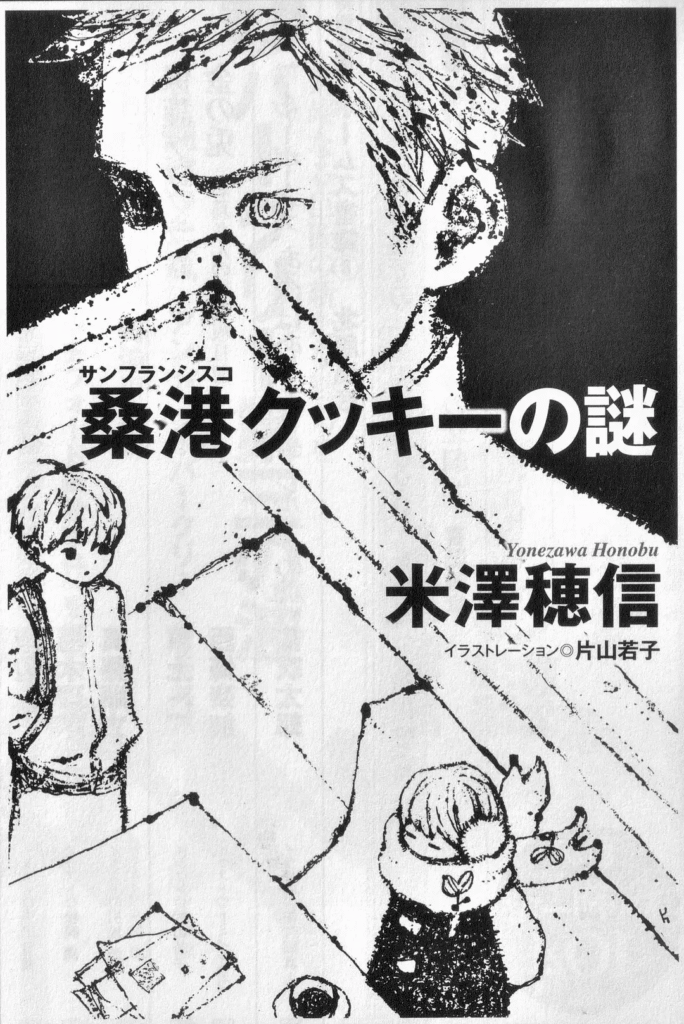
It all began with a newspaper. It was followed by another newspaper, and another, and another, then for some reason led to a cookie.
Basically, what happened was this. One winter day, after returning from school, I opened the newspaper for some reason. I skimmed through the social section, sports section, and the next section without finding anything particularly interesting, and when I opened the local news section, there was a headline in the corner of the page that read “Kira City Native Wins Art Exhibition Award.” It said that a local artist, Shima Taiga, had won the Black Bear Award at the San Francisco Biennale with his work “Gaze and Shell”.
On the article, it was written that Mr. Shima graduated from Funado High School in this city and was 47 years old. It did not explain what “Gaze and Shell” was or how prestigious the Black Bear Award was. There was a photo of him, and he had a gentle smile that was completely unrelated to the sternness one might associate with an award-winning artist.
At first, I couldn’t decide how to react to this information in a petit bourgeois way. On one hand, I thought it was small-minded to completely forget about something that had nothing to do with me, while on the other hand, I felt it was quite appropriate to take pride in the success of a senior from my high school who was recognized worldwide. I couldn’t come to a conclusion on this dilemma, and without feeling the need to conclude anything, I forgot about the article at that moment.
After half a month later, I encountered the name Shima Taiga again. When I arrived at school, there was a school newspaper on every student’s desk with the headline “Our School Graduate Wins Art Exhibition Award” written in large letters. It seems that the newspaper club had chosen to take pride in Shima-shi’s award.
According to the article, the Biennale is an art exhibition held every two years. It mentioned that the Venice Biennale and São Paulo Biennale are world-renowned, and then explained that the San Francisco Biennale is an honor next to the highest award, the Gray Bear Award.
As expected, there was no photo of the award-winning “Gaze and Shell”, but it was understandable that the school newspaper club had been unable to obtain it. Instead, they used a photo from the graduation album, which appeared to be a face shot of him in a school uniform. Since Shima Taiga was 47 years old, this would be a photograph from nearly 30 years ago. I couldn’t help but wonder if they had obtained permission from the artist to publish his photo.
The third time I encountered the name Shima Taiga was during the fifth period of that day. As soon as the class started, Hirata-sensei, the Japanese history teacher, held up the school newspaper with a beaming smile and said:
“Everyone, have you read this?”
Hirata-sensei was a teacher who usually had a stern face on. He would lecture us about the regency government structure while lamenting indignantly about the Fujiwara clan’s hegemony1, and would teach the Kamakura period while choking up about the fates of Yoriie and Sanetomo2. After staring at the school newspaper for a while, he continued with words full of emotion.
“Shima was a classmate of mine. He never attended alumni gatherings, so I always wondered what he was doing, but it turned out he has become quite successful. It’s probably hard for you to understand, but at this age, it’s just nice to know that someone you’ve been out of touch with is alive and well.”
Since Shima-shi was 47 years old, Hirata-sensei was probably around the same age. In fact, I thought he was a bit older. Hirata-sensei continued with a beaming smile.
“He was in the art club. As they say, ‘Sandalwood is fragrant even as a sapling,’ those who are destined to succeed are different when they’re young. However, not all those who are different at a young age will become successful. There are also those who were ordinary in their youth but grow up later. This is about math. Are you all good at math?”
Watching Hirata-sensei, who was more talkative than usual, I was thinking about the right to be happy. Hirata-sensei joyfully spoke of Shima-shi’s global success as if it were his own, and his tone when talking about their relationship was even somewhat boastful, but I didn’t find it unnatural. So, if I were to take joy in Shima-shi’s success in the same way and act boastfully towards someone else, would that also make sense? Wouldn’t the thin relationship between Shima-shi and me create an ugly situation like a fox borrowing the ferocity of a tiger? Hirata-sensei slapped the school newspaper with the back of his hand.
“He was a strange guy. I remember he was fast. Yes, he was quite fast. It’s nostalgic. But I’ve never seen his works. Koumura-sensei, the art teacher, is also in the same grade, and I’ve seen Koumura-sensei’s paintings, but I don’t remember seeing Shima’s. What a pity.”
Where would the threshold be for being allowed to rejoice in someone else’s success as if it were your own? Did I have the right to rejoice in the success of a fellow alumnus like Hirata-sensei? While thinking about this issue, I listened to Hirata-sensei’s story. In the afternoon of the fifth period, lulled by the warmth of the heater, I was absentmindedly pondering such things.
Also on the following Friday, I encountered the name Shima Taiga again. The name was mentioned by Doujima Kengo from the newspaper club, and the location was in the hallway on my way home. However, it wasn’t that Shima Taiga’s name came up all of a sudden. When Kengo saw me, he exchanged a standard greeting and then scratched his head a bit awkwardly before saying:
“Hey Jougorou, I don’t know if it’s okay to ask you this, but…… could you introduce me to Osanai?”
There was always a certain level of tension between me and Doujima Kengo.
Kengo thought of me as a roundabout deceiver, and I pretending not to notice that truth was probably an act of kindness from him. I couldn’t really say we got along very well. It was quite unexpected that Kengo would ask me to be an intermediary between him and Osanai-san.
“To Osanai-san?”
I asked, my voice a little shrill.
“Is there something you need?”
Osanai-san, or Osanai Yuki, was just a normal student in the school. At least, she aspired to be that way and lived a much more inconspicuous school life compared to me. There shouldn’t be many people who knew about her original personality that she wished to discard.
And Kengo was one of those few people. Last spring, due to unavoidable circumstances, I’d told Kengo about what kind of person Osanai-san used to be. However, it was hard to say whether Kengo believed it or not.
Kengo was completely serious. “I want to consult her about something. She helped me out before, remember?”
Osanai helped out Kengo…?
“What was it?”
“You forget about other people quickly, huh? It was about the painting. The most refined painting in the world.”
“… Ah.”
Of course, I remembered.
That also happened in spring. The issue was whether to continue storing a painting left in the clubroom by a graduated art club member or to dispose of it. Due to certain circumstances, the newspaper club got involved in this issue, and I was also dragged into it.
“It was Osanai who solved the mystery of that painting. I want to borrow that wisdom again.”
Indeed, that case was solved by Osanai-san. In reality, it was a joint effort between me and Osanai-san, so it was understandable that Kengo’s phrasing of “she helped me out” didn’t quite resonate with me. In other words, Kengo’s evaluation that I forget about others quickly was incorrect. Anyway, the fact that he wanted to contact Osanai-san in relation to that case meant…
“Is there another strange painting?”
Kengo hesitated in his response.
“Rather than strange… well, I suppose it is strange… but it’s also a bit serious.”
“I can’t imagine a painting left at school becoming a serious problem. Unless it’s a cursed painting that eats people or something.”
“In a way, that might have been more comfortable.”
Kengo looked around as if to guard against eavesdropping and lowered his voice even more.
“There’s a painting by Shima Taiga left behind. Do you know Shima Taiga?”
“Of course.”
It was good to be able to answer that. If I hadn’t remembered the name Shima Taiga, which was prominently featured in the school newspaper, Kengo from the newspaper club would have felt a little depressed.
“He won an award at the San Francisco something, right? If that person’s painting was found, it would be a big discovery.”
“Well, that’s true.”
Kengo said this with a bit of hesitation and scratched his head again.
“… I think it’s better to see the actual thing. Jougorou, come with me.”
Perhaps I should have politely declined, especially when I could see that a troublesome situation was unfolding. But I couldn’t do that. Kengo had started walking without waiting for my reply, and I’d missed the timing to decline. That too was certainly a fact.
But I had to admit, I was somewhat curious about what kind of painting could cause such a “serious” problem that would make Kengo want to rely on Osanai-san.